
How to Obtain a Colombian Marriage Visa: Your Complete Application Guide

Embarking on a new chapter with a Colombian partner is an exciting journey, and making Colombia your permanent home is a dream for many. For foreigners married to a Colombian national, this dream is made possible through a specific legal pathway: the Colombian Marriage Visa. This visa is more than just an entry permit; it’s the foundation for building a life, working, and integrating fully into the rich tapestry of Colombian society.
This comprehensive guide is designed to demystify the entire application process. We will walk you through everything from understanding the legal framework and gathering essential documents to navigating the online submission and securing your residency. Whether you are just beginning to explore your options or are ready to start your visa application, this article provides the clarity and expert insights you need to succeed.
What is the Colombian Marriage Visa (Visa de Cónyuge)?
The Colombian Marriage Visa, officially known as the Migrant Visa Type M-1 (M-1 Visa) or Visa de Cónyuge, is a specific category within the broader system of Colombian Visas. It is designed exclusively for foreign nationals who are legally married to a Colombian citizen.
This visa grants the holder the right to reside in Colombia for a period of up to three years. Critically, it also allows the holder to work and engage in any lawful activity in the country. It serves as the primary legal instrument that formalizes your status as a resident based on your marital bond, distinguishing it from temporary visitor or tourist permissions. Understanding its official designation as an M-1 Visa is key when navigating the forms and regulations of the Ministry of Foreign Affairs.
Who Needs a Colombian Marriage Visa? (Foreigners marrying a Colombian citizen)
Simply put, any foreign national who is legally married to a Colombian citizen and intends to live in Colombia must obtain this marriage visa. It is not an optional step for long-term cohabitation. This requirement applies regardless of where the marriage took place—whether it was a ceremony in Bogotá or one in another country. To establish legal residency in Colombia based on your marriage, the Colombia marriage visa is the mandatory and correct pathway. It is the formal recognition of your union by Colombian immigration authorities.
Why Obtain This Visa? Pathway to Residency and Beyond
Obtaining the Colombian Marriage Visa is a pivotal step with long-term benefits that extend far beyond simply being able to live in the country. It is a direct and stable pathway toward permanent residency and eventual Colombian Citizenship.
After holding the M-1 Visa continuously for just two years (as per recent updates), you become eligible to apply for a Resident Visa (Type R). This permanent resident visa solidifies your status in Colombia, granting you nearly all the rights of a citizen, such as the freedom to work without sponsorship and to come and go from the country without restriction. While marriage rates in Colombia may seem low compared to other nations, with a crude marriage rate of 1.4 per 1,000 people according to the OECD, for those who do marry, it provides this powerful and streamlined route to long-term legal residency.
Related Topics of Interest for You:


Colombian Marriage Laws: Civil Code and Legal Framework
The legal foundation for marriage in Colombia is established in the Civil Code of Colombia. The law defines marriage as a solemn contract between two individuals to live together and provide mutual support. For immigration purposes, the specific regulations are dictated by Resolution 5477 of 2022, issued by the Ministerio de Relaciones Exteriores (Ministry of Foreign Affairs). This resolution is the cornerstone of the modern Colombia Visas system, outlining the exact Legal requirements, documentation, and procedures for every visa category, including the spouse visa. Your union must be legally recognized under these statutes for your application to be successful.
Types of Recognized Unions for Visa Purposes
For the purpose of an M-1 Visa, the Colombian government primarily recognizes a formal civil marriage. However, it’s important to understand the distinction between this and another common type of union:
- Civil Marriage (Matrimonio Civil): A legally binding marriage officiated by a Colombian notary (notario) or civil judge, or a marriage legally performed and registered in another country. This is the direct basis for the M-1 Visa.
- Common-Law Union (Unión Marital de Hecho): Also known as a unión libre or civil union, this is a legally declared permanent partnership between two people who have cohabited for at least two years. While this union can also be the basis for a Migrant Visa, it is for a different sub-category (M-type Permanent Partner) and requires a formal declaracion union marital de hecho from a notary or judge. This guide focuses specifically on the M-1 Visa for legally married spouses.
The Role of Notaries and the Registraduría Nacional del Estado Civil
In Colombia, notaries (notarios) play a crucial role in civil life, including officiating and formalizing marriages. When a civil marriage takes place in Colombia, the notary issues a public deed (escritura pública). This deed is then registered with the Registraduría Nacional del Estado Civil, the national entity responsible for maintaining vital records. This registration generates the official Colombian marriage certificate (Registro Civil de Matrimonio), which is the single most important document for your visa application if you were married within the country.
Brief Note on Same-Sex Unions and Visa Eligibility
Colombia has been a leader in Latin America for LGBTQ+ rights, legalizing same-sex marriage in 2016. Consequently, same-sex marriages are fully recognized for all legal purposes, including immigration. A foreigner in a legally recognized same-sex marriage with a Colombian citizen is fully eligible to apply for the M-1 Marriage Visa under the exact same terms and conditions. The increasing acceptance is clear, as in 2022, 1,546 same-sex couples married in Colombia, the highest number since legalization, as reported by Golden Harbors.
General Requirements for All Applicants
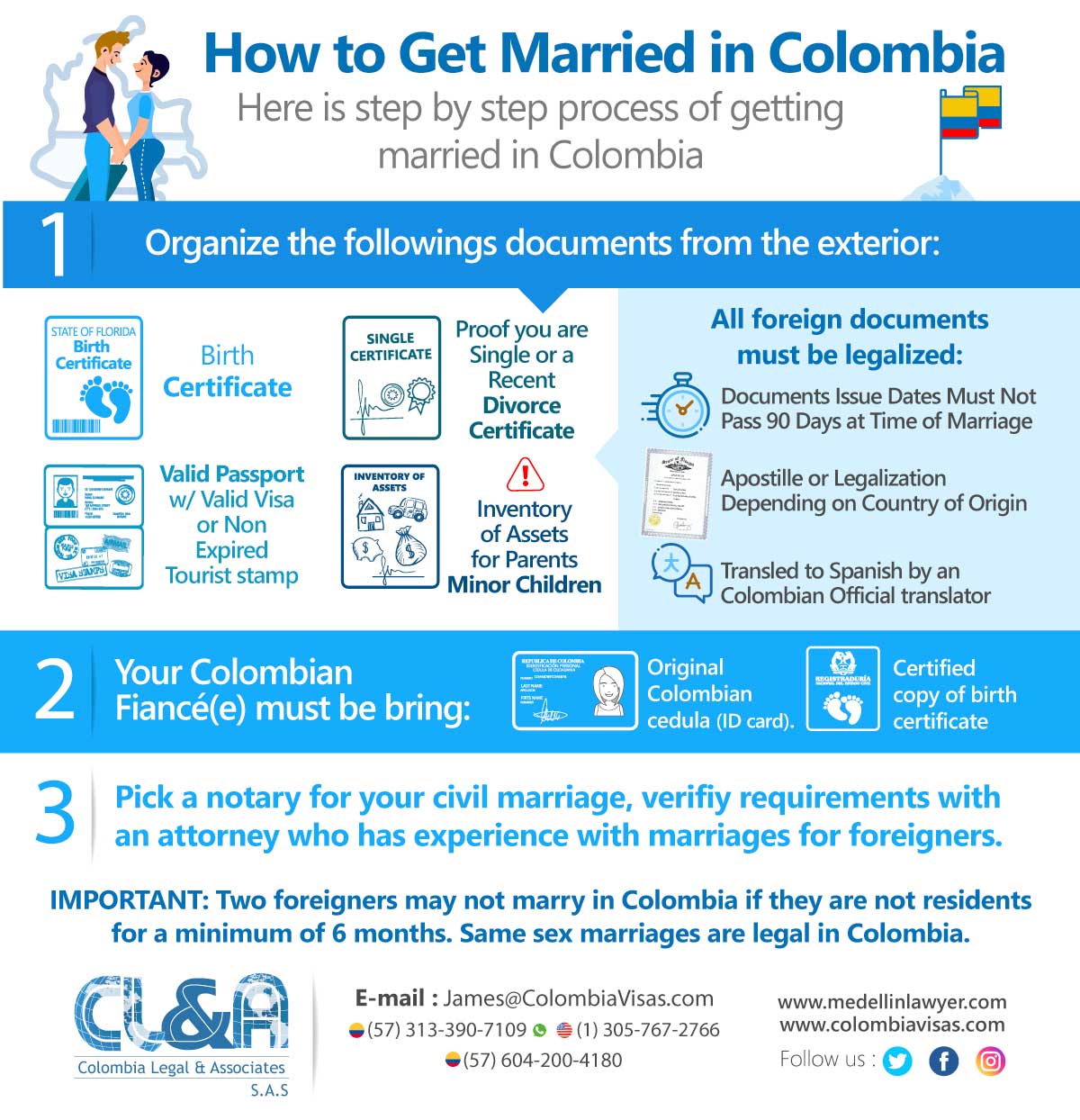
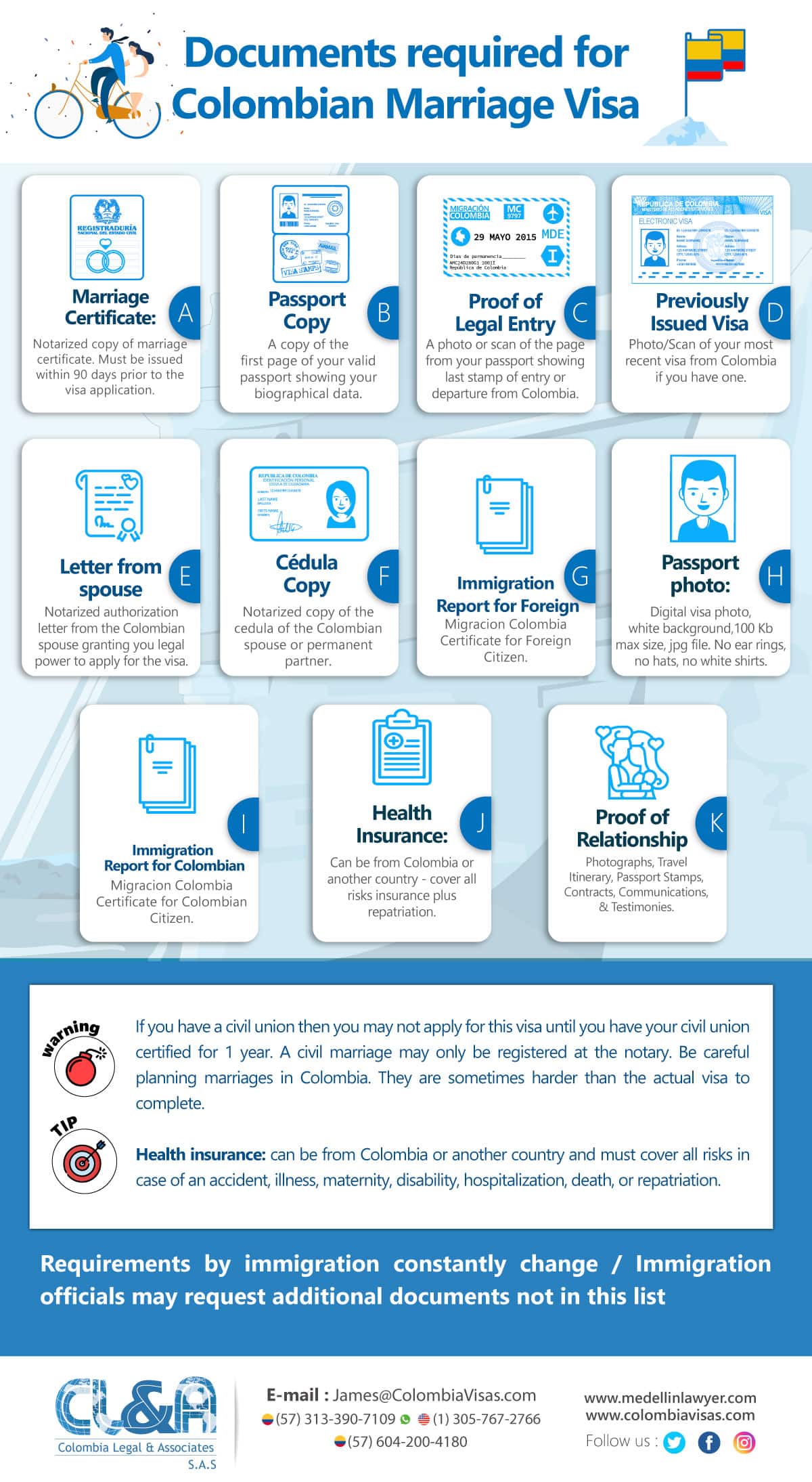
When preparing your visa application, both the foreign applicant and the Colombian spouse must provide specific documentation. The following is a checklist of the core Legal requirements.
Documents from the Foreign Applicant:
- Valid Passport: A clear, color scan of your passport’s main data page. The passport must have at least two blank pages and be valid for at least six months beyond the visa’s duration.
- Passport-Style Photo: A recent digital photo (3×4 cm) with a white background, facing forward.
- Proof of Legal Entry: If applying from within Colombia, a scan of the passport page with your most recent entry stamp or Tourism Stamp Extension.
- Criminal Background Check: A national criminal background check from your country of residence for the last three years. For US citizens, this is typically an apostilled FBI background check.
- Birth Certificate: A copy of your official birth certificate. Depending on your nationality, it may need to be apostilled and translated.
- Health Insurance: Proof of a Health Insurance policy with coverage in Colombia for risks including accident, illness, maternity, disability, hospitalization, and repatriation.
Documents from the Colombian Spouse
The Colombian partner’s role is crucial in sponsoring the application. They must provide:
- Cédula de Ciudadanía: A clear, legible copy of their Colombian national ID card.
- Official Request Letter: A signed letter formally requesting the M-1 Visa for their foreign spouse. The letter should state the full names and identification numbers of both individuals, confirm they live together (or plan to), and take responsibility for the foreign spouse’s expenses and potential departure costs.
- Proof of Marriage: This is the cornerstone of the application.
- If married in Colombia: A recent copy (issued within the last 3 months) of the Colombian civil marriage record (Registro Civil de Matrimonio).
- If married abroad: The foreign marriage certificate must be legalized with an Apostille (for Hague Convention countries like the US) or by a Colombian consulate. It must then be officially translated into Spanish by a certified translator in Colombia and registered with a Colombian notary or the Registraduría Nacional del Estado Civil to produce a valid Colombian marriage record.

|
|


Phase 1: Pre-Application – Document Preparation and Legalization
This initial phase is the most critical and time-consuming part of the application process. Meticulously gather every document listed above for both you and your spouse. Pay close attention to legalization requirements; foreign documents like your birth certificate or criminal background check will need a US Apostille or equivalent legalization, followed by a Certified translation into Spanish. Scan every document into a clear, high-quality PDF file, as the entire initial submission is digital.
Phase 2: Online Application Submission
The entire visa application is initiated online through the official SITAC web portal of the Ministry of Foreign Affairs (Ministerio de Relaciones Exteriores). You will need to complete the Formulario Único de Trámites (Unified Procedures Form).
During this step, you will:
- Fill out the online application form with your Datos personales (personal information), ensuring it matches your passport exactly.
- Answer questions about your visa history and travel plans.
- Upload the prepared PDF scans of all required documents to the platform. Any attempt to access a requested resource that is not yet available or improperly formatted may lead to a web server error, so ensure your files are correct.
Phase 3: Payment, Review, and Approval
After submitting the online form, you will receive instructions to pay the initial study fee. This fee is non-refundable, regardless of the outcome. Once payment is confirmed, a visa officer will review your application. This review can take from a few business days to several weeks. The officer may:
- Approve the visa: You will be notified and required to pay the final issuance fee.
- Request more information (requerimiento): You will be asked to upload additional documents or clarifications. You must respond promptly.
- Deny the visa: The officer will provide a reason for the denial.
Phase 4: Visa Stamping and Entry to Colombia
Upon payment of the final fee, you will receive your electronic visa (eVisa) via email. This is your official visa. If you applied from outside Colombia, you must visit a Colombian consulate (e.g., the one in Fort Lauderdale) to have the physical visa sticker placed in your passport before traveling. If you applied from within Colombia, you can schedule an appointment at the Ministry of Foreign Affairs office in Bogotá to get the visa stamped.


If you do not speak Spanish fluently, then an official interpreter is required. Please be aware that official interpreters charge about $100 to appear. The cost of a marriage at a notary in Colombia is about 300,000 pesos.
All documents must have an apostille or legalization stamp from the state or providence you live in. If you are legalizing documents then you must send your documents to the local Colombian consulate before coming to Colombia. All documents must be translated to Spanish by an official Spanish translator.
Three articles Similar to Colombia Marriage Visa:
 Learn what is a Civil Union in Colombia by visiting Medellin Lawyer now!
 Explore the process of how to get Colombia Parent Visa, and start your journey today!
 Find out quickly 10 Things you should know before you send in your K1 visa at Colombia Visas!
Registering with Migración Colombia
This is a mandatory step that cannot be skipped. Within 15 calendar days of receiving your visa stamp (if in Colombia) or of entering the country with your new visa, you must register it with Migración Colombia. This registration, known as the Registro de Extranjeros, is done online and finalized at a local migration Colombia office. Failure to register on time results in hefty fines and complicates your legal standing.
Obtaining Your Cédula de Extranjería (Foreign ID Card)
Immediately after registering your visa, you must apply for your Cédula de Extranjería (Foreign ID card). This is the official Colombian ID card for foreign residents and is essential for daily life. You will need it to open a bank account, sign a lease, enroll in the health system, and conduct almost any official transaction. The process is managed by Migración Colombia and involves an online application followed by an in-person appointment for fingerprinting and a photo.
Benefits of Your Visa and Cédula
With your stamped M-1 visa and your Cédula de Extranjería in hand, you are officially a legal resident of Colombia. This status provides immense stability and unlocks numerous opportunities. You have the right to work for any employer or start your own business without needing separate permission. You can open bank accounts, acquire property, and fully integrate into the economic and social fabric of the country. This combination of documents marks the successful end of your migration process and the beginning of your new life.
Important Considerations, Common Pitfalls, and Expert Tips
Navigating the Colombia marriage visa process requires attention to detail. Here are some expert tips to avoid common pitfalls:
- Document Recency: Ensure your Colombian marriage certificate is issued within three months of your application date. The government wants to see the most current record.
- Translation Accuracy: Only use official translators certified by the Colombia Ministry of Foreign Affairs. A poor or unofficial translation is a common reason for rejection.
- Financial Solvency: While not always explicitly listed with a fixed amount for the spouse visa, the Colombian partner’s letter of sponsorship implies financial responsibility. It is wise to be prepared to demonstrate stable income or savings if requested.
- Prenuptial Agreements: If you have Prenuptial Agreements, they do not directly impact the visa application, but they are an important legal consideration for marriage under the Civil Code of Colombia.
- Technical Glitches: The government’s online portal can sometimes be buggy. If you encounter an Error 403 HTTP status code, it often indicates a permission issue or access control problem from the web server blocking your client request. Try clearing your browser cache, using a different browser, or accessing the site via a VPN with a Colombian IP address.
- Seek Professional Help: The Legal requirements can be complex, especially when dealing with foreign document legalization. Firms like Visas by James or Colombia Legal & Associates SAS specialize in Colombian Visas and can save you time, stress, and costly mistakes.
Related Topics of Interest for You:
Conclusion
Securing a Colombian Marriage Visa is a meticulous but highly rewarding process that paves the way for a stable and fulfilling life with your spouse in Colombia. From understanding the legal framework of Resolution 5477 to carefully preparing each document like your marriage certificate and proof of Health Insurance, every step is crucial. This M-1 Visa is your official entry into the Colombian community, granting you the right to work and live as a resident.
This visa is the key that unlocks the door to long-term stability, including the pathway to a Permanent Resident Visa and ultimately, Colombian Citizenship. By following this guide, paying close attention to detail, and seeking expert help when needed, you can confidently navigate the application process and begin building your future together in the heart of South America.
Related Articles of Interest: Colombia Visas
Real-World Colombian Marriage Visa Case Patterns for Expats
Marriage in Colombia While Waiting for U.S. Spouse Visa Approval (Daniel & Laura)
Daniel, a U.S. citizen, married Laura, a Colombian national, in Medellín and applied for a Colombian Marriage Visa so he could remain in Colombia part time while waiting for U.S. immigration approval.
The initial file relied too heavily on the marriage certificate and lacked broader relationship documentation. This is a common issue when couples underestimate how relationship evidence is evaluated across visa processes.
The renewal delay was corrected by expanding proof of relationship, clarifying travel patterns, and aligning the Colombian Marriage Visa strategy with the structure of the U.S. spouse visa process.
Living in Colombia During U.S. Spouse Visa Processing (Michael & Ana)
Michael and Ana married in Colombia and lived there while waiting for U.S. immigration approval. Economic solvency issues arose because income existed but was poorly documented.
These cases often require financial documentation that matches expectations outlined in standard Colombian Marriage Visa application reviews, especially when income is earned abroad.
The case was resolved by submitting structured bank statements, an employment letter explaining remote work, and shared household expense records.
Short-Term Marriage With Long-Term Immigration Planning (Eric & Sofía)
Eric married Sofía in Colombia and planned to divide time between countries while pursuing a U.S. spouse visa. The relationship was genuine but initially under-documented.
The file was strengthened by expanding relationship proof, clarifying travel timelines, and coordinating Colombian residency planning with the spousal immigrant visa timeline in the United States.
How the Colombian Marriage Visa Is Evaluated in the Legal Process
In the Colombian Marriage Visa legal process, authorities don’t evaluate the case based only on civil status. They evaluate whether the relationship is documentable, continuous, and operational in Colombia. The initial filing creates a baseline that is often re-audited during renewal.
Initial Application: Where Most Structural Failures Begin
Failure to Establish Documentable Proof of Relationship Beyond the Marriage Certificate
A primary cause of weakness is failing to establish documentable proof of relationship beyond the civil registry. Couples often submit only the marriage certificate and a few photos, but the legal process expects independent proof points that match the relationship timeline.
If you need a practical checklist of relationship evidence that typically strengthens these files, review this guidance on how to document a real relationship for visa review.
When the relationship is long-term but the legal form of the union is different, this resource on qualifying through a recognized marital partnership can help clarify common proof expectations.
Failure to Meet Economic Solvency to Show Ability to Live in Colombia
Economic solvency problems arise when neither spouse documents how living expenses will be covered in Colombia. Bank statements, employment letters, income certifications, or documented spousal support are commonly used to establish stability.
For a broader step-by-step view of what tends to make a complete filing (and what creates delays), see this overview on building a stronger marriage visa application.
If the marriage process itself created documentation gaps (for example, notary-level issues that later affect the visa file), this page on fixing common notary marriage obstacles is often relevant before filing or renewing.
Renewal Stage: Where Behavior Overrides Paperwork
Colombian Marriage Visa Renewal Failure Due to Lack of Documented Marital Residence in Colombia
At renewal, authorities verify behavior—not just documents. A key risk factor is when immigration movement reports indicate the Colombian citizen spouse maintained residency outside Colombia rather than inside the country during the visa period.
Many couples underestimate renewal scrutiny. This general resource onwhat renewals tend to audit and why
helps explain why approvals can be revisited later.
Experience Handling Colombian Marriage Visa Problems Over Time
Many of the most serious marriage visa problems do not appear during the first application. They surface later—during renewal cycles, when residence patterns are reviewed, or when couples begin long-term residency planning. At Visas by James, these same failure patterns have appeared repeatedly in corrective cases involving renewals, inadmissions, and delayed approvals. That experience matters because it helps identify structural weaknesses early—before they become barriers that are much harder to fix inside the legal process.
PAA FAQ: Common Questions About the Colombian Marriage Visa
Is a marriage certificate enough to get a Colombian Marriage Visa?
Not usually. The legal process often expects documentable proof of relationship beyond civil status, especially when the relationship history is short or the file has inconsistencies.
Why is a Colombian Marriage Visa approved initially but denied at renewal?
Renewals are a confirmation audit. Authorities compare the original file against actual behavior during the visa period, including residence patterns and immigration movement reports.
Can a Colombian Marriage Visa renewal be denied if the Colombian spouse lived abroad?
Yes. Even if the marriage is genuine, renewal can fail when immigration records suggest the Colombian citizen spouse maintained residency in the exterior.
What financial proof helps with a Colombian Marriage Visa?
Bank statements, an employment letter, income certifications, and documented spousal support can establish economic solvency when they match the household reality and are consistent across the file.
What happens if proof of relationship is weak?
Weak proof often triggers delays, additional evidence requests, or non-admission decisions—sometimes at renewal rather than the first filing.
How do couples usually fix marriage visa problems after a denial or non-admission?
Corrective cases typically include a structured explanation, updated evidence that clarifies the record, and documented steps that restore residence and household continuity in Colombia.
How to Apply for Colombia Marriage Visa?
There are two ways to apply for Colombian Marriage visa.
Applying for Marriage visa from abroad
A visa applicant who wishes to invest in Colombia can apply for a Colombia Marriage visa online. In addition, any Colombian visa can be obtained at any Colombian consulate around the world. In the U.S., Colombia has consulates located in the following cities and states:
The Colombian visa application process is not easily completed online due to limits of pages and size of digital documents. This application will require scanned copies of all required documents in Adobe PDF format along with your passport photo in JPEG format. In addition, a detailed guide for applying online can be found here.
If you are outside Colombia, you must go to the nearest Colombian consulate. There, you can get the visa added to your passport. Once your application has been approved you will receive a digital pdf file to print out, you are ready to travel to Colombia as a migrant visa holder.
The Colombian visa application process is fairly easy as it can be completed entirely online. You can apply for a Colombia Marriage visa online Tramites Visa . This application will require scanned copies of all required documents in Adobe PDF format along with your passport photo in JPEG format. In addition, a detailed guide for applying online can be found here.
If you are in another country outside of Colombia, then you have to go to nearby Colombian consulate in that country so that you can get the visa added to your passport at a Colombian consulate. Once your Colombian investment visa has been approved and added to your passport, you are ready to travel to Colombia as a migrant and an investor.

Applying for Marriage Visa from Colombia
Once you receive online visa approval, if doing this in Colombia, you need to travel to Bogotá to get the visa in your passport. Visas in Colombia are issued at the Ministerio de Relaciones Exteriores office in Bogotá. Their office is located at Avenida 19 # 98-03, Torre 100 Building, 3rd Floor. It’s open from 7:30 am until noon.

The major challenge with getting a Colombian visa yourself is dealing with a government bureaucracy, making a trip to Bogota and not understanding the laws properly if you are not fluent in Sanish.
This is where you can benefit from the services of an experienced visa agency such as Visas by James. A visa agency such ours is your best bet when it comes to obtaining visa for you. An experienced visa agency which has processed hundreds of visas and knows exactly what is needed for each type of visa is exactly what you need.
Another big benefit of using a visa agency is that they offer services to courier your passport to Bogotá to get the visa put in your passport. So, you can avoid a trip to Bogotá. The cost of a visa service including the service to courier your passport to Bogotá can even be cheaper than the cost of a trip to Bogotá.
Our Path to Becoming Colombia's Leading Visa Agency
James Lindzey founded ColombiaVisas.com after relocating to Colombia in 2005. With experience as a private investigator and paralegal in the U.S., James brought a strong legal background to Colombia's complex visa system.
Today, Visas by James—part of Colombia Legal & Associates SAS—is a top provider of visa and legal services for expats. We specialize in U.S. immigration services for Colombians migrating to the USA, and Expats from countries around the world migrating to Colombia.
In addition to our visa services, our agency offers a full range of legal and accounting services to our clients. We can better assist clients with document collection services for documents located in the United States because of James's prior legal experience there.
We also maintain contact with over 800 notaries, registries, and Colombian courts to obtain any documents required in Colombia.


What Clients Say About Working With Us
Real feedback from clients who have worked with our team on Colombian visa and legal processes.
Client feedback is sourced from publicly available third-party review platforms. Individual results may vary.
“I worked with Visas by James Medellín and had an excellent experience. Once I was connected with Isabela, I felt confident I was on the right path to obtaining my visa.”
— Mathew Sickler
“The Visas by James team helped significantly with my U.S. visa, and the process went much smoother than expected. They were knowledgeable and helpful throughout.”
— Mohan Chander Narasimman
“Visas by James is the company to use for visa services. My experience was excellent, and Lorena was absolutely amazing to work with.”
— Benjamin
“The team was responsive and professional. They provided clear guidance and helped me understand the visa process from beginning to end.”
— Robert Nepon
“Very professional service. All steps were clearly explained, and they helped me avoid mistakes that could have delayed my visa.”
— Reynaldo Araujo
“Overall, a positive experience. Communication was good, and the process was explained in a way that made sense for a foreigner.”
— Justin Halladay
Important Legal Disclaimer
The information on this page is provided for general informational purposes only and does not constitute legal advice, immigration advice, or a guarantee of any specific visa outcome.
Colombian visa requirements, procedures, government fees, and internal criteria change frequently and may vary depending on your personal situation and the policies in force at the time of your application.
Always consult a qualified professional to receive advice tailored to your individual case. Reading this website does not create an attorney–client relationship with Colombia Legal & Associates SAS, Visas by James, or any member of our team.
Client Reviews – Visas by James
Note: The star rating summary and excerpts are based on publicly available reviews shown for Visas by James on third-party review displays. Individual experiences may vary.
 Our main office is located in Medellin, Colombia near Parque Lleras in El Poblado. We have representation in Bogota, Miami, and Fort Lauderdale. Our main office address is Cra 39#5A-95, Oficina 709, Edificio Avangarde. We accept walk in appointments but its always nice if you can let us know ahead of time so we can schedule a time. Areas codes in Colombia have changed. To reach our office please call (57) 604-200-4180.