
Colombia 180-Day Rule in 2026: How to Count Your Days, Extend Your Stay, and Avoid Overstay Fines
The Colombia 180-day rule lets most tourists stay up to 180 days per calendar year, from January 1 through December 31, usually as 90 days on entry plus a possible 90-day extension. Leaving Colombia does not reset the clock, and overstaying can lead to fines of up to 7 SMLMV, delays, and future immigration problems.
If you want to stay legal, count every day physically spent in Colombia, apply for any extension before your current stay expires, and resolve any overstay before trying to leave the country. If you may need more time than the tourist framework allows, review the main Colombian visa options before your permitted stay runs out.
Quick Answer: What Is the Colombia 180-Day Rule in 2026?
You can stay in Colombia for a maximum of 180 days per calendar year, from January 1 through December 31. It is not a rolling 12-month system.
- You usually receive an initial 90-day PIP entry permission.
- You may request an additional 90-day extension before expiration.
- Leaving Colombia does not reset your days during the same calendar year.
- Overstays can trigger sanctions that may reach up to 7 SMLMV, depending on the case.
- If you already overstayed, do not assume you can solve it at the airport.

Use This 30-Second Check to See If You’re Still Legal
If you want a fast answer, this is the quickest way to check your status.
- When did you first enter Colombia this year?
- How many total days have you spent inside Colombia since January 1?
- Did you already use your 90-day extension?
- Are you close to day 80–90 of your current stay?
If you cannot answer these clearly, you are already at risk of miscalculating your legal stay.
Related Topics of Interest for You:


Why Is the 180-Day Rule So Important in Colombia?
Your calendar matters more than your passport stamps. In Colombia, legal tourist stay is measured against the calendar year, not your personal travel rhythm.
Colombia’s 180-day rule operates on a strict January 1 to December 31 basis. Every day you spend on Colombian soil counts toward that annual ceiling. If you cross into a new year while still in Colombia, those new-year days count against the new annual allotment. There is no carryover, no grace period, and no automatic forgiveness for partial-year misunderstandings.
What surprises many travelers is the compounding effect: 90 days in the spring, a trip abroad, then another 90 days in Medellín or Bogotá later in the year can fully consume your legal stay before the year ends.
What Changes If You Enter Colombia Late in the Year?
Entering late in the year can create unexpected legal timing problems.
If you arrive in November or December, your stay may extend into the next calendar year. While your day count resets on January 1, your initial 90-day period does not automatically reset in the same way. This creates confusion: travelers assume a “new year = new 180 days,” but your legal status depends on both your entry permission and your accumulated days.
This is one of the most misunderstood parts of the Colombia 180-day rule.
Why Don’t Border Runs Work in Colombia?
Because Colombia counts cumulative days inside the same calendar year. A short trip to Panama, Ecuador, or Mexico does not restart your annual tourist allowance.
A common mistake among digital nomads is believing a quick exit resets the clock. It does not. In practice, Migración Colombia reviews your cumulative annual presence, not just your most recent entry stamp. For readers comparing tourist-day rules with longer-term solutions, this Colombia visa guide is a useful starting point.
Can You Reset the 180 Days by Leaving Colombia?
No. Leaving Colombia does not reset your 180-day total during the same calendar year.
This is one of the most common search questions and one of the most common reasons travelers accidentally overstay. The rule is calendar-based, not trip-based.
What Is the Difference Between a Tourist Permit and a Tourist Visa?
For many nationalities, Colombia is not issuing a traditional tourist visa on entry. It is issuing permission to stay.
This distinction matters because travelers often assume they hold a visa when they are really operating under an entry permission framework. Extensions are administrative, not automatic rights, and immigration officers still have discretion at entry. This confusion is one of the reasons travelers misunderstand how long they can legally remain in Colombia. For a separate tourist-entry resource, see How to Get Colombia Tourist or Visitor Visa.
What Is the Difference Between PIP and PTP?
PIP is your initial entry permission. The extension is the administrative step that can add time, up to the annual maximum.
- PIP (Permiso de Ingreso y Permanencia): The standard entry permission stamped into your passport upon arrival — typically granting 90 days.
- Extension / prior PTP terminology: The administrative extension request that can add up to 90 additional days, for a combined maximum of 180 in the calendar year.
Conflating the two is one of the most common compliance errors travelers make. If you are unsure how tourist entry permission differs from a visa-based stay, see how the Colombian visa framework works in practice.
How Should You Verify Your Day Count?
Use official records, not memory. If your own count and the migration database do not match, the migration record usually controls the practical outcome.
Before calculating any extension, verify your official day count through the Migración Colombia portal. Discrepancies between physical stamps and database records are not uncommon.

|
|
Not Sure How Many Days You Have Left?
If your remaining days are unclear, it is safer to verify now than to discover a problem when trying to extend or leave.
We help travelers and expats calculate legal stay, identify overstay risk, and choose the right next step before the issue becomes more expensive.
How Do You Calculate Your Remaining Days in Colombia?
Count every calendar day you are physically inside Colombia between January 1 and December 31, then subtract that total from 180.
This is the intent most readers actually have: not just understanding the rule in theory, but knowing whether they are legal right now.
What Is the Simple Formula?
- Total days physically in Colombia since January 1
- Subtract that number from 180
- The result is the maximum number of tourist days remaining for that calendar year
What Do Real Examples Look Like?
- Example 1: Enter January 10 and leave March 10. That is 60 days. Return July 1 and you still have 120 days available for the rest of the year.
- Example 2: Stay 90 days, leave for a week, then return. You do not get a new 180-day allotment. You have only 90 days left.
- Example 3: Enter on December 28 and stay into January. Those January days count toward the new calendar year, not the old one.
What Actually Happens in Practice?
Migración Colombia tracks more precisely than most travelers do. If your personal count does not match the internal record, that mismatch can create problems when you extend, exit, or re-enter.
Migración Colombia tracks entries and exits through both passport control and the internal migration database.
What Happens From Entry to Overstay: Timeline
This is how the 180-day rule usually unfolds in practice.
- Day 1: You enter Colombia and receive your initial PIP.
- Day 1–80: You remain in legal tourist status.
- Around Day 80: Best practical time to request your extension.
- Day 90: Initial stay period expires if no extension has been granted.
- Day 91+: Overstay risk begins if you remain without valid extension or other status.
Can Immigration Give You Less Than 90 Days?
Yes. Entry is discretionary, and not every traveler receives the full 90 days.
While many travelers expect 90 days automatically, immigration officers may grant a shorter period depending on your travel history. :contentReference[oaicite:6]{index=6}
How Do You Extend Your Tourist Stay in Colombia?
You usually extend tourist time by requesting the additional period before your original stay expires. Waiting too long is one of the most common ways people fall out of status.
What Happens on the Initial 90-Day Stamp?
Your first period usually starts with a 90-day entry permission.
When you enter Colombia as a tourist, the immigration officer generally stamps your passport with a Permiso de Ingreso y Permanencia (PIP).
When Should You Apply for the Extension?
Apply before day 80 if possible. That timing gives you a practical buffer.
Colombia’s extension process requires submission before your current permission expires. :contentReference[oaicite:7]{index=7}
What Actually Happens If You Apply Late?
Late applications create real risk. A pending request does not always protect you if approval does not arrive before expiration.
Applications submitted after day 85 are often risky. Some applicants receive no response before expiration.
What Documents Should You Prepare in Advance?
- Valid passport (at least 6 months validity)
- Proof of financial solvency
- Round-trip flight itinerary
- Completed digital application via Migración Colombia
How Do You Confirm Approval?
Look for a formal approval, not just a vague email. Keep the approval available offline in case you need it later.


What Common Mistakes Lead to Overstays in Colombia?
Most overstays are caused by misunderstanding, not by deliberate abuse.
- Assuming that leaving Colombia resets the 180-day total
- Waiting until day 88, 89, or 90 to request an extension
- Miscalculating days across multiple trips in the same year
- Trusting passport stamps over the official database
- Submitting incomplete or poorly translated support documents
- Thinking an overstay can be solved casually at the departure gate
For foreign documents, many delays happen because applicants file without proper apostilles or coordinated document preparation. If your records or support evidence are foreign, compare that with the site’s document services guidance and visa application tips. :contentReference[oaicite:6]{index=6}
What Does Overstaying in Colombia Actually Cost?
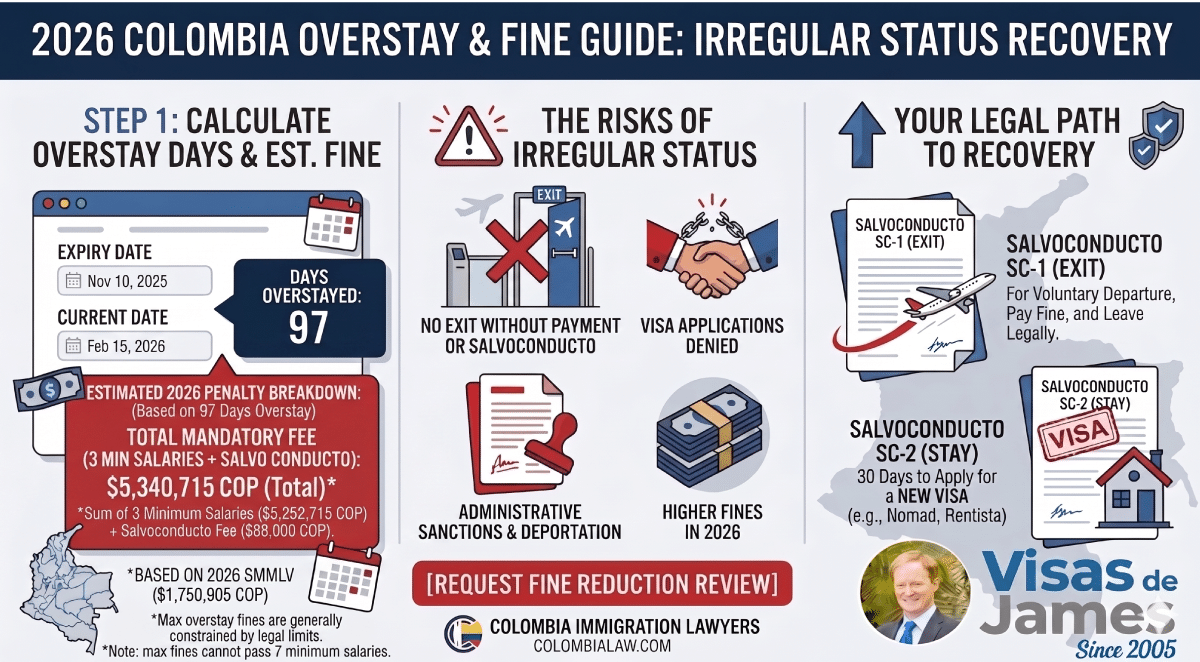
Irregular stay can trigger sanctions that may range from ½ SMLMV up to 7 SMLMV, depending on the facts of the case and the authority’s evaluation.
The safer legal framing is salary-based, not exaggerated peso ranges that exceed the sanction ceiling.
What Is the Cost Breakdown in Simple Terms?
If you want the practical version, this is what matters most:
- Short overstays may still trigger a formal sanction.
- Longer overstays usually increase scrutiny and risk.
- Repeat problems can make your case more serious even if the current overstay is not extreme.
- The legal ceiling should not be described above 7 SMLMV.
What Is the Legal Sanction Range?
The range is from ½ SMLMV up to 7 SMLMV. That is the clean ceiling this article follows throughout.
Overstay penalties are not one-size-fits-all. Under Colombia’s migration sanction framework, irregular stay can trigger an economic sanction ranging from half of one monthly minimum salary up to seven monthly minimum salaries, depending on the facts of the case and the authority’s evaluation.

What Do Real Overstay Scenarios Look Like?
| Overstay Duration | Likely Sanction Framing | What Usually Happens |
|---|---|---|
| 1–3 days | Often closer to the lower end of the range | Usually a lower-tier sanction, but still a formal violation |
| 4–30 days | Varies by circumstances and history | More scrutiny and more urgency to resolve before departure |
| 30–90 days | Can rise materially depending on the facts | Higher-risk case, often requiring more direct intervention |
| 90+ days | May approach the upper end of the sanction range | Serious compliance problem with potential future-entry consequences |
Can You Pay the Fine at the Airport?
You should not rely on that. In practice, waiting until departure often makes the situation worse, not easier.
Migración Colombia does not handle these issues as casually as a parking ticket at the gate. Attempting to leave with an unresolved overstay can trigger review, delay, or missed flights.
What Happens if You Overstay in Colombia?
The problem is not only the fine. You may also face delays, extra in-person steps, document review, departure complications, and a harder time on future entries or applications.
Can You Be Banned From Colombia?
Not every overstay leads to a ban, but the risk rises when the facts get worse. Repeated violations, longer irregular stays, or poor case handling can create future entry restrictions or a more difficult immigration record.
Airport Reality: What Actually Happens at Exit Control?
If you leave Colombia after an overstay, the airport is not where you want to discover the problem. Exit control is where unresolved irregular stay can become immediately disruptive.
What Can Happen at Exit Control?
- Your passport may be flagged during the departure process.
- You may be pulled aside for additional review.
- You may be told the case must be addressed with Migración Colombia before departure.
- You may miss your flight if the issue is not already organized.
Why Is This Such a High-Risk Moment?
Because by then your schedule is fixed and your options are narrower. Travelers often underestimate how quickly a simple day-count problem becomes a missed-flight problem once departure day arrives.
What Is the Best Way to Avoid Airport Problems?
Resolve the overstay before the day of travel. If your status is unclear, your days are close, or you already overstayed, handle the issue early rather than hoping exit control will be flexible.
Explore Related Services: These related legal and visa resources may help you plan the next step more strategically:
- Protect long-term assets with Colombian estate planning for foreigners once you start building ties in Colombia.
- Check Colombian tax residency rules for foreigners if time in country could change your filing duties.
- Consider a living trust in Colombia if you need a longer-term asset-protection strategy.
- See whether the Colombia Rentista visa is a better fit if your case depends on passive monthly income.
- Compare the broader options on the main Colombia visas guide before choosing your long-term plan.
Already Close to an Overstay or Out of Status?
Once your legal stay is unclear, waiting usually makes the situation harder. Departure problems, extra procedures, and future immigration issues often begin with small delays that were ignored too long.
We help clients resolve overstays, prepare supporting documents, and coordinate the next legal step before travel plans are disrupted.
How Does the Salvoconducto Process Work for Legal Exit?
If you already overstayed, the Salvoconducto may be part of the legal path to exit or regularize your status. It is not a magic fix, but it can be an important administrative bridge.
What Is a Salvoconducto?
A Salvoconducto is a temporary authorization used to bridge an irregular or transitional immigration situation.
It is an administrative instrument issued by Migración Colombia that can give you a short, defined window to exit the country legally or file a visa application.
Where Do You Handle It?
You usually handle it in person. Bring your passport, prior immigration records, and copies of supporting documents.
How Should You Handle the Interview?
Be direct and consistent. Explain when you entered, how you exceeded your permitted stay, and what you are trying to do next.
How Much Time Does a Salvoconducto Usually Give You?
Often a short window, not a long-term solution. If you cannot appear in person, Colombiavisas also offers broader legal support.
What Do Real Cases Look Like in Practice?
Mark: Stayed 92 days. Resulted in a formal fine process and two lost days resolving the matter.
Sofía: Applied on day 88. Approval didn’t arrive in time; had to resolve it administratively.
Daniel: Used multiple border runs. On re-entry, he was questioned aggressively and denied the expected stay.
What Should You Do If You Want to Stay Longer Than 180 Days?
If your real goal is long-term time in Colombia, tourist status is often the wrong tool.
Is the Digital Nomad Visa a Better Option?
Often yes. For remote workers who want to avoid repeated day counting, the Colombian Digital Nomad Visa is the cleanest strategy.
Is the Investor Visa Better for Property Buyers?
It can be. Foreigners buying property should compare the tourist route against the Colombia real estate investment visa.
What Is the 183-Day DIAN Tax Trap?
Crossing 183 days of physical presence within a 365-day period may trigger DIAN tax residency.
When Should You File a Visa Application?
While you are still in valid status. Filing after expiration creates a status gap that can complicate review.
How Do Tourist Stay, Digital Nomad Visa, and Investor Visa Compare?
The best option depends on your purpose, timing, and tolerance for compliance obligations.
| Option | Best For | Main Advantage | Main Trade-Off |
|---|---|---|---|
| Tourist stay with PIP + extension | Short-term travelers | Fastest and simplest initial route | Hard annual day cap and overstay risk if mismanaged |
| Digital Nomad Visa | Remote workers | Removes the tourist-day countdown | Requires documentary support and ongoing compliance |
| Investor Visa | Property buyers and investors | More stable long-term framework | Requires qualified investment and stronger planning |
How Does Colombia Compare to Other Tourist-Stay Systems?
Many travelers make mistakes because they import assumptions from other countries.
- Schengen Area: commonly understood as a 90/180 rolling framework, which is different from Colombia’s calendar-year structure.
- Mexico: entry outcomes can involve more officer discretion in practice.
- Thailand: many travelers associate it with visa-run culture, which creates the wrong expectation in Colombia.
The strategic takeaway is simple: assumptions that may work elsewhere can create problems in Colombia.
What Should Visa Holders Watch for When Traveling Outside Colombia?
Visa holders can also lose status if they stay outside Colombia too long.
What Are the Main Absence Rules by Visa Category?
- Resident (R) Visa holders: More than 2 consecutive years outside Colombia can trigger automatic cancellation.
- Migrant (M) Visa holders: Absences exceeding 6 continuous months can create serious risk depending on the category.
How Does Migración Colombia Track Time Outside the Country?
Electronically and systematically. Every border crossing contributes to the record.
Migración Colombia cross-references entry and exit stamps electronically. Every border crossing is logged against the immigration file.
How Should You Audit Your Own Absence Window?
- List all exit and return dates from your passport.
- Calculate the longest continuous period spent outside Colombia.
- Compare that against your visa category threshold.
- If you are close to the limit, get guidance before your next trip.
Three articles Similar to Colombia 180 Day Rules:
 Understand exactly how to get Colombia Student Visa with expert guidance at Colombia Visas!
 Explore the opportunities with a Colombia Digital Nomad Visa and start your adventure today!
 Find out quickly how to get Colombia rentista visa annuity visa at Colombia Visas!
Why Clients Ask for Help Before Leaving Colombia
- They are not sure how many legal days they have used.
- They applied late and do not know whether they are already out of status.
- They want to avoid airport problems, fines, or future-entry issues.
- They need a safer transition from tourist status to a visa option.
What Should You Do Next? A Practical Decision Guide
Most readers do not need more theory. They need to know which path fits their situation.
What Is the Best Option If You Want to Stay Less Than Six Months?
Use the tourist framework correctly. Count your days from January 1, apply early for any extension, and do not rely on border runs.
What Is the Best Option If You Already Overstayed?
Resolve it before departure. Do not rely on airport improvisation or assume the issue will disappear on its own.
What Is the Best Option If You Want to Stay Long-Term?
Move out of the tourist framework entirely. For many remote workers, the better answer is a visa strategy. Start with the Digital Nomad Visa.
What Is the Worst Option If You Want to Reduce Risk?
Waiting and hoping. The worst option is to assume you can explain everything later after deadlines have already passed.
What Should You Do This Week Based on Your Situation?
Your next step depends entirely on where you are in your stay timeline.
If you are under 80 days: You still have time, but you should be planning your extension.
If you are between 80 and 90 days: You are in the risk zone. Apply immediately.
If you already overstayed: Do not wait until departure. Resolve it before trying to leave.
If you want to stay long-term: Transition into a visa strategy instead.
What Is the Clear Recommendation?
If your goal is short-term travel, manage your tourist days precisely. If your goal is repeat or long-term stays, transition into a visa category early. If you are already out of status, treat it as a legal compliance issue now.
FAQ: Colombia 180-Day Rule and Overstays
Does leaving Colombia reset the 180 days?
No. Colombia counts tourist days across the calendar year, not by rolling trips or border crossings.
How do I avoid overstay problems in Colombia?
Count days precisely, apply early, verify records when needed, and do not wait until the airport to solve a status problem.
Can I pay an overstay fine at the airport?
You should not count on that. In practice, overstays usually need to be addressed before departure.
Can I extend my stay after 90 days?
In many cases, yes — but you must request the extension before the original period expires, and early filing is safer than waiting until the end.
What happens if I overstay by one day?
Even a short overstay can still trigger a fine and force you into a formal resolution process.
Can I return to Colombia after overstaying?
Possibly, but long or repeated overstays can affect how your next entry is treated.
Conclusion: Your 2026 Legal Compliance Checklist
Colombia’s tourist-stay system is manageable if you track it early and act before problems stack up.
The 180-day calendar-year rule is the foundation of every compliance decision you make: counted January 1 through December 31, with no automatic reset.
- Count every day — partial days count and migration records matter.
- Use the extension window early before your allowed time expires.
- Respect the sanction ceiling — penalties may reach up to 7 SMLMV.
- Know your exit path — a Salvoconducto may be required if you overstayed.
Compliant travel in Colombia is achievable with proactive tracking. If you missed the deadline, get qualified guidance before attempting to leave.
Need Help With a Colombia Overstay, Extension, or Visa Strategy?
Avoid fines, missed flights, or rejected filings. Get clarity before your current status expires or before you try to leave the country.
We assist with tourist stay analysis, overstay resolution, visa transitions, and immigration strategy.
Related Immigration and Document Services

What Clients Say About Working With Us
Real feedback from clients who have worked with our team on Colombian visa and legal processes.
Client feedback is sourced from publicly available third-party review platforms. Individual results may vary.
“I worked with Visas by James Medellín and had an excellent experience. Once I was connected with Isabela, I felt confident I was on the right path to obtaining my visa.”
— Mathew Sickler
“The Visas by James team helped significantly with my U.S. visa, and the process went much smoother than expected. They were knowledgeable and helpful throughout.”
— Mohan Chander Narasimman
“Visas by James is the company to use for visa services. My experience was excellent, and Lorena was absolutely amazing to work with.”
— Benjamin
“The team was responsive and professional. They provided clear guidance and helped me understand the visa process from beginning to end.”
— Robert Nepon
“Very professional service. All steps were clearly explained, and they helped me avoid mistakes that could have delayed my visa.”
— Reynaldo Araujo
“Overall, a positive experience. Communication was good, and the process was explained in a way that made sense for a foreigner.”
— Justin Halladay
Important Legal Disclaimer
The information on this page is provided for general informational purposes only and does not constitute legal advice, immigration advice, or a guarantee of any specific visa outcome.
Colombian visa requirements, procedures, government fees, and internal criteria change frequently and may vary depending on your personal situation and the policies in force at the time of your application.
Always consult a qualified professional to receive advice tailored to your individual case. Reading this website does not create an attorney–client relationship with Colombia Legal & Associates SAS, Visas by James, or any member of our team.