
N-400 Citizenship Application Guide for Colombians, Spouses of U.S. Citizens, Veterans and Green Card Holders
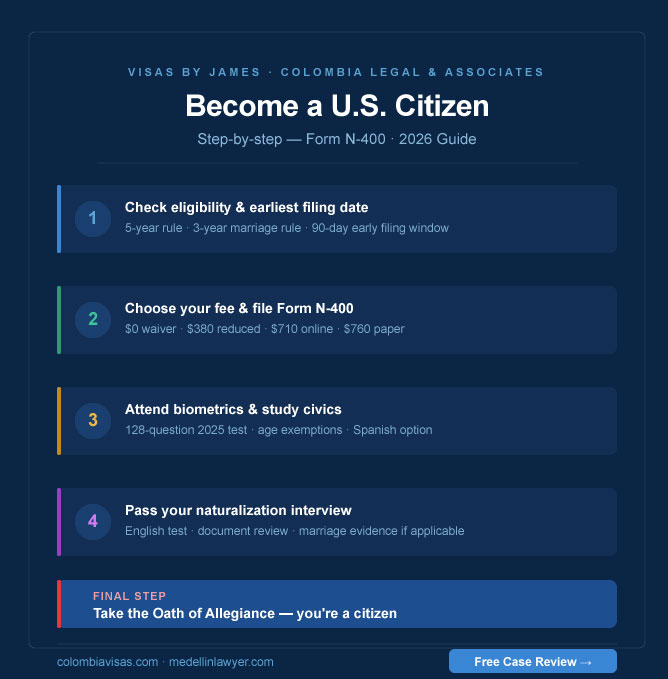
This 2026 guide breaks down everything in plain English (with a few Colombian-specific notes thrown in because that is who we help every day): the real eligibility rules, the new 2025 civics test with 128 questions, the current filing fees, the document checklist, how long it takes, the fee waiver and reduced-fee situation, the 3-year marriage rule and the famous 90-day early filing window, the issues Colombian applicants run into, military and veteran evidence, mistakes that get cases denied, and when it is worth paying an attorney to look things over before you file.
🆕 What changed in 2026 — quick rundown:
- New civics test: Anyone who files on or after October 20, 2025 takes the new 128-question civics test, not the old 100-question version.
- New form edition: USCIS only accepts the 01/20/2025 edition of Form N-400. The “X” gender marker is gone.
- No more checks: As of October 28, 2025, paper filings must pay by credit card (Form G-1450) or ACH (Form G-1650). No more personal checks or money orders.
- Filing fees: $710 online, $760 paper, $380 reduced fee (150%–400% FPG), $0 with full fee waiver. Biometrics are bundled in.
- Processing times: National median around 5.5–8 months as of early 2026, with field offices ranging from under 3 months to 18+ months.
Related Topics of Interest for You:


Primary call to action: Download the Free N-400 Document Checklist
Secondary call to action: Request an N-400 Case Review
Quick Answer: What Is the N-400 Citizenship Application?
Form N-400, officially called the Application for Naturalization, is the USCIS form a green card holder uses to ask the U.S. government for citizenship. A few things it is not: it is not a green card renewal, it is not the removal of conditions on a 2-year marriage green card (that is Form I-751), and it is not automatic. USCIS is going to actually read your file and decide whether you meet the legal requirements — things like time as a permanent resident, time physically in the country, English and civics, good moral character, and loyalty to the Constitution.
Here is the part most blogs skip: for a clean applicant, the N-400 really does feel like paperwork. Fill it out, show up, raise your hand, done. But for an applicant with even one weak spot — a long trip back home, a DUI from years ago, a tax year you skipped, a marriage that ran cold — the N-400 turns into a deep dive into your travel history, your taxes, court records, military records, and how you got your green card in the first place. That is why we always say: do not just fill out the form. Screen yourself first.
⚠️ Legal review point: Filing for citizenship can wake up old questions about your original immigration case. If your green card came from marriage, a job, asylum, military service, or a family petition, the story you tell on the N-400 has to match the one you told back then. Inconsistencies are what kill cases at the interview.
Table of Contents
- Who Qualifies for U.S. Citizenship Through N-400?
- N-400 Filing Fees and Cost in 2026
- Fee Waiver and Reduced Fee Rules (Form I-912 & I-942)
- Does Your Spouse’s Income Count for N-400 Fee Help?
- N-400 Requirements for Naturalization
- English & Civics Test Exemptions (50/20, 55/15, 65/20)
- The 3-Year Marriage Rule and 90-Day Early Filing Calculator
- How Long Does N-400 Take? 2026 Processing Times
- N-400 for Colombians Applying for U.S. Citizenship
- N-400 for Veterans, Military Members and Military Families
- Can You File N-400 With a Pending I-751?
- N-400 Document Checklist
- Common N-400 Mistakes That Can Delay or Deny Citizenship
- N-400 Interview Preparation
- N-400 FAQ

Who Qualifies for U.S. Citizenship Through N-400?
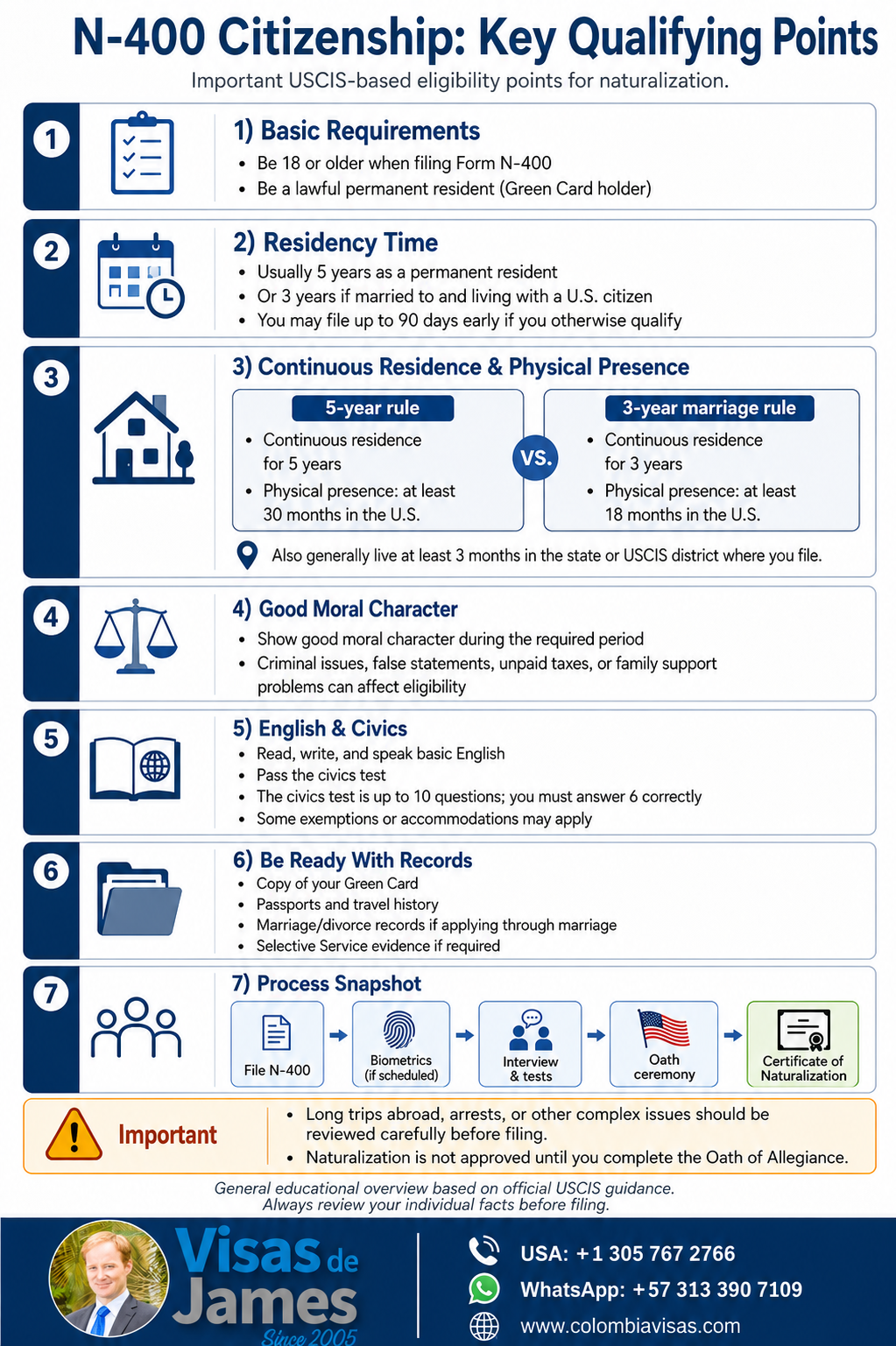
Most people get to citizenship through one of a handful of pathways. The pathway you use decides how far back USCIS looks, how many days you needed to be physically in the country, what documents you have to bring, and where the risks are. The classic 5-year rule is by far the most common, but the 3-year marriage rule and the military rules can move things along faster — if you actually qualify.
| Applicant Type | Common Rule | Key Evidence |
|---|---|---|
| 5-Year Green Card Holder | Usually 5 years as a lawful permanent resident before you can apply. | Green card, travel history, tax records, address history, employment history, court records if any. |
| Spouse of U.S. Citizen | Usually 3 years as a permanent resident while married to and living with a U.S. citizen spouse. | Marriage certificate, spouse’s proof of citizenship, joint residence records, marital union evidence. |
| Military Member | May qualify under special military rules. | N-400, Form N-426, military service certification, good moral character evidence. |
| Veteran | Depends on service history, service period, and discharge. | DD-214, NGB Form 22, discharge records, service history, court records if any. |
| Pending I-751 Applicant | Can usually file N-400 if otherwise eligible, but I-751 must be resolved before citizenship is approved. | I-751 receipt, extension notice, updated marriage evidence, interview prep for both cases. |
📊 3-Year vs. 5-Year Rule — Tap to Compare Side-by-Side
| Factor | 5-Year Rule (General Provision) | 3-Year Rule (Spouse of U.S. Citizen) |
|---|---|---|
| Time as LPR | At least 5 years | At least 3 years |
| Physical presence required | At least 30 months in the U.S. | At least 18 months in the U.S. |
| Continuous residence | 5 years | 3 years |
| Marriage requirement | None | Must be married to AND living with the same U.S. citizen spouse for at least 3 years |
| Spouse citizenship requirement | None | Spouse must have been a U.S. citizen for at least 3 years |
| 90-day early filing | Yes (~4 years 9 months from green card) | Yes (~2 years 9 months from green card) |
| State residence | 3 months in your state/district | 3 months in your state/district |
| Good moral character lookback | 5 years | 3 years |
| Form box (Part 1) | Box 1.A. | Box 1.B. |
| Risk level | Lower (no marriage dependency) | Higher (depends on marital union evidence) |
Bottom line: The 3-year rule sounds like a shortcut, but it carries more risk because USCIS scrutinizes the marriage. If your marriage situation is at all complicated, you may actually be better off waiting for the 5-year clock.
A Colombian green card holder applies under exactly the same rules as anyone else. The Colombian angle matters in practice, though, because so many of our clients have frequent travel back to Colombia, Colombian passports with stamps everywhere, Spanish-language civil records, and Colombian marriage or divorce papers that need certified English translations before USCIS will look at them.
N-400 Filing Fees and Cost in 2026
Let’s get the money question out of the way up front. Here is what it actually costs to file Form N-400 in 2026:
| How You File | Filing Fee | Includes Biometrics? |
|---|---|---|
| Online (USCIS account) | $710 | ✅ Yes |
| Paper (by mail) | $760 | ✅ Yes |
| Reduced fee (income 150%–400% of poverty guidelines) | $380 | ✅ Yes — paper only |
| Full fee waiver (income ≤150% FPG or means-tested benefits) | $0 | ✅ Yes — paper only |
| Active military / certain veterans | $0 | ✅ Yes |
💡 Save $50 by filing online — unless you need a fee waiver or reduced fee, in which case you must file by paper.
🚨 Critical 2026 change — no more checks or money orders. As of October 28, 2025, USCIS no longer accepts personal checks, business checks, cashier’s checks, or money orders for paper filings. You must pay by credit/debit card using Form G-1450 or by ACH bank transfer using Form G-1650. Mailing a check now means automatic rejection.
🚨 Use the right form edition. USCIS only accepts the 01/20/2025 edition of Form N-400. Older forms downloaded from third-party sites or saved from prior years will be rejected. Always download fresh from uscis.gov/n-400 right before filing.
What’s Included in the Fee?
Since April 2024, biometrics are bundled into the N-400 fee. You no longer pay a separate $85 biometrics fee. USCIS can still require you to attend an Application Support Center appointment for fingerprints, photo, and signature — you just do not pay extra for it.
What’s NOT Included
- Certified translations of Spanish documents (typically $20-50 per document).
- Apostille fees if any document needs legalization.
- Attorney fees if you hire one (typically $500-$2,500 for a standard case in our market, higher for complex cases).
- Travel to the interview and oath ceremony.
- Your first U.S. passport after naturalization (separate fee to the State Department).
Fee Waiver and Reduced Fee Rules (Form I-912 & I-942)
Many applicants focus only on whether they qualify for citizenship, but fee eligibility can change the filing strategy. A person who qualifies for a fee waiver may save the full $760 N-400 filing fee. A person who does not qualify for a full waiver may still qualify for the reduced $380 fee if household income falls under the 400% FPG threshold.
🚨 Important: Applicants requesting a fee waiver or reduced fee cannot file online and must submit the paper filing package with the required financial evidence.
2026 Poverty Guideline Planning Table
Use this as a planning aid only. The official USCIS poverty-guideline chart should be checked before filing because the thresholds get adjusted and Alaska and Hawaii have different (higher) numbers.
| Household Size | 150% FPG — Full Fee Waiver Threshold (Form I-912) | 400% FPG — Reduced $380 Fee Threshold (Form I-942) |
|---|---|---|
| 1 | $23,940 | $63,840 |
| 2 | $32,460 | $86,560 |
| 3 | $40,980 | $109,280 |
| 4 | $49,500 | $132,000 |
| 5 | $58,020 | $154,720 |
| 6 | $66,540 | $177,440 |
| 7 | $75,060 | $200,160 |
| 8 | $83,580 | $222,880 |
Figures based on the 2026 HHS Poverty Guidelines for the 48 contiguous states and D.C., effective Jan. 13, 2026. Alaska and Hawaii use different (higher) numbers.
How the brackets work:
- Income at or below 150% FPG → Form I-912 → potentially $0 (full fee waiver).
- Income between 150% and 400% FPG → Form I-942 → $380 (half the regular fee).
- Income above 400% FPG → full fee ($710 online or $760 paper).
Documents for a Fee Waiver or Reduced Fee Request
If you are asking for fee help, the package is what makes or breaks it. Gather as much of this as applies to you:
- IRS tax transcripts or federal tax returns;
- W-2s, 1099s, pay stubs, and proof of current income;
- unemployment or disability benefit records;
- proof of any means-tested benefits (SNAP, Medicaid, SSI, TANF, etc.) if you are applying on that basis;
- household member income records;
- child support or alimony obligations;
- rent, medical bills, or other hardship evidence if you are claiming you cannot pay;
- a written explanation if your income changed after your last tax return.
Do not guess at fee help. If the request is weak, USCIS rejects the whole package and you lose months waiting to refile.

Does Your Spouse’s Income Count for N-400 Fee Help?
This question comes up constantly, and it is genuinely confusing because of one easy-to-make mistake: people mix up Form N-400 fee help with the Form I-864 Affidavit of Support they signed during the green card stage. They are completely different tests.
For N-400 fee waiver or reduced-fee purposes, USCIS looks at documented household income and household size against the poverty guidelines. So yes — your spouse’s income probably counts, because your spouse is usually part of your household. But that is not the same as saying your U.S. citizen spouse is your “sponsor” for the N-400. There is no sponsor on the N-400. The question is just whether your household, as a unit, qualifies financially for fee help.
Common Mistakes With Spouse Income
- Filing a fee waiver showing only the immigrant spouse’s income while ignoring what the U.S. citizen spouse brings in.
- Submitting tax returns from two years ago that no longer match what the household actually earns.
- Claiming separation for fee purposes but still using joint documents elsewhere on the N-400. USCIS notices these inconsistencies.
- Not explaining a job loss or income drop that happened after the last tax return.
- Assuming foreign income just disappears. It may still be relevant to your household picture.
- Trying to use the 3-year marriage rule while financial documents quietly suggest you and your spouse are not actually living together anymore.
For Colombian applicants this gets especially tricky if one spouse moved between Colombia and the U.S. recently, has foreign income, sends money to family back home, or has tax records that do not line up year to year. The safest move is to tell one clean story across all your documents.
N-400 Requirements for Naturalization
The exact requirements shift a bit depending on your filing category, but every applicant has to clear most of the same hurdles. Let’s walk through them.
Age Requirement
You generally have to be at least 18 when you file. Easy. Where this gets interesting is with families: if you have a child under 18 living with a U.S. citizen parent, the kid might already be a U.S. citizen automatically and not need an N-400 at all. Worth checking before you spend the filing fee.
Lawful Permanent Resident Status
You have to be a green card holder. The “Resident Since” date printed on your green card is the official start of your clock — not the day you got married, not the day your immigrant visa was stamped, not the day the green card showed up in the mail. Get this date wrong and you will file too early.
Continuous Residence
Continuous residence means the U.S. has been your real home during the lookback period. This is not the same as physical presence (we will get to that next). You can rack up enough total days in the country and still have a continuous residence problem if you took a really long trip, moved abroad for work, gave up your U.S. housing, stopped filing taxes as a U.S. resident, or basically acted like your real life was somewhere else.
Physical Presence
Physical presence is the straightforward day-counting test: how many actual days were you inside the United States?
- 5-year applicants: usually need at least 30 months physically in the U.S. during the 5-year lookback.
- 3-year marriage-based applicants: usually need at least 18 months physically in the U.S. during the 3-year lookback.
Pro tip — start counting now. Most people guess way too high about how much they were home.
State or USCIS District Residence
You also need to have lived for at least 3 months in the state (or USCIS district) where you file. This trips up people who just moved, military families, students, and applicants who split their year between two states.
Good Moral Character
This is the big one for risk. USCIS can look at criminal records, taxes, child support, probation, immigration fraud, lies on prior applications, selective service registration, DUIs, domestic violence allegations, and pretty much anything that speaks to your character during the lookback period. Even an old issue may need to be disclosed if the N-400 form asks about it. The rule of thumb: if in doubt, disclose and explain. Hiding things is almost always worse than the thing itself.
English and Civics Requirements
Most applicants take the English reading, writing, and speaking sections plus the civics test. There are exceptions for older long-time green card holders (see the next section), for medical disability, and for some other situations.
🆕 New 2025 civics test (important!): If you file your N-400 on or after October 20, 2025, you take the new 2025 civics test with 128 possible questions (up from 100 in the 2008 version). If you filed before that date, you still take the older 2008 test. The format is similar — the officer asks you a sample of the questions and you answer orally — but there are more topics covered. Try our free practice quiz below.
Spanish-speaking applicants — please do not just memorize the 128 civics questions and call it a day. The officer is going to interview you in English about your own form, so you also need to understand what you are saying yes or no to.
🎓 Free 2025 Civics Test Practice Quiz
Sample questions from the new 128-question civics test. Tap “Show answer” to reveal. The Spanish translation is shown for reference only — at the interview you answer in English (unless you qualify for one of the exemptions below).
¿Cuál es la ley suprema de la nación?
Nombre una rama o parte del gobierno.
¿Cuántos senadores de Estados Unidos hay?
¿Por cuántos años elegimos a un senador de Estados Unidos?
¿La Cámara de Representantes tiene cuántos miembros con derecho a voto?
¿Quién es el comandante en jefe del ejército?
¿Cuáles son los dos partidos políticos principales de Estados Unidos?
¿Quién escribió la Declaración de Independencia?
¿Cuándo se adoptó la Declaración de Independencia?
¿Cuál es la capital de Estados Unidos?

English & Civics Test Exemptions (50/20, 55/15, 65/20)
This section deserves its own spotlight because a lot of older Colombian applicants do not realize they may qualify for major exemptions that let them take the civics test in Spanish, with an interpreter, and skip the English test entirely.
The Three Age + Residency Exemptions
| Rule | Who Qualifies | What You Get |
|---|---|---|
| 50/20 | Age 50 or older at filing, with 20+ years as a lawful permanent resident | Exempt from English test. Take the civics test in your native language (Spanish) with an interpreter you bring. |
| 55/15 | Age 55 or older at filing, with 15+ years as a lawful permanent resident | Exempt from English test. Take the civics test in your native language with an interpreter. |
| 65/20 | Age 65 or older at filing, with 20+ years as a lawful permanent resident | Exempt from English test, can take civics in Spanish, AND you get a simplified civics test with only 20 questions (need to answer 6 correctly). |
🎯 Why this matters for Colombian applicants: A 67-year-old Colombian who has had a green card since 2002 (24 years) qualifies for the 65/20 exemption. She takes a simplified 20-question civics test, in Spanish, with her daughter as the interpreter. No English test. No 128-question study burden. This is a path many older applicants do not realize exists.
Medical Disability Exemption (Form N-648)
If you have a physical or developmental disability or mental impairment that has lasted (or is expected to last) 12 months or more, you may be exempt from the English test, the civics test, or both. A licensed medical professional fills out Form N-648 to certify the condition.
This is not a loophole — USCIS reviews N-648 carefully and rejects vague or template-style certifications. The doctor has to explain the specific condition, how it prevents the applicant from meeting the requirement, and the medical basis for the conclusion. Get a real medical opinion from a doctor who knows you, not a “naturalization doctor” who fills out forms for $200.
Bringing an Interpreter
If you qualify for an English exemption, you must bring your own interpreter to the interview. The interpreter has to be at least 18 years old, fluent in both English and your native language, and they cannot be your attorney or anyone you are paying to represent you. A family member, friend, or hired interpreter works — bring their photo ID.
The 3-Year Marriage Rule and 90-Day Early Filing Calculator
This is one of the most searched and most misunderstood pieces of U.S. immigration. Quick version: if you are married to a U.S. citizen, you might be able to apply for citizenship after 3 years as a green card holder instead of waiting the full 5. But the rule is not literally “married for 3 years.” It is more involved than that.
If you started the whole journey from Colombia, you have probably already touched some of these pieces — the CR-1 spousal visa guide covers the visa that gets a foreign spouse to the U.S., and the K-1 fiancé visa from Colombia covers the alternative for couples who get married after arrival. The USA marriage and fiancé visa comparison walks through which one fit your situation. The N-400 is just the last chapter of that same story.
🧮 Free 90-Day Early Filing Calculator
Plug in your green card “Resident Since” date and your filing basis. The tool will tell you the earliest day you can mail your N-400.
The Rule Is Not Just “Married for 3 Years”
To use the 3-year rule, the applicant generally has to show:
- they are at least 18 years old;
- they have been a lawful permanent resident for at least 3 years;
- they have been married to the same U.S. citizen spouse for at least 3 years;
- the spouse has been a U.S. citizen for at least 3 years (this trips people up when the spouse only recently naturalized);
- they lived in marital union with the U.S. citizen spouse during the required period (in plain English: still actually married and living as a couple, not just legally married on paper);
- they meet continuous residence and physical presence requirements;
- they meet good moral character and everything else.
Five different dates matter here: your green card date, your marriage date, your spouse’s citizenship date, when you actually started living together, and your travel history. They all have to line up.
90-Day Early Filing Window
USCIS lets eligible applicants file up to 90 days early — meaning 90 days before they would have completed the required residence period. For a 3-year marriage case, that often means filing around 2 years and 9 months after the green card “Resident Since” date. But — and this is important — the 90-day window only applies to the continuous residence calculation. You still have to meet every other requirement on the actual day you file.
Do not file early just because the green card date is getting close. Confirm the spouse’s citizenship date, your marital union evidence, your physical presence days, taxes, and travel before you mail anything.
Marriage-Based Red Flags
We strongly recommend legal review if:
- the spouses are separated;
- the spouses have different addresses;
- you filed taxes separately and cannot explain why;
- the U.S. citizen spouse only recently naturalized;
- the applicant had long trips outside the United States;
- the I-751 is still pending;
- the marriage evidence is thin;
- there are prior divorces, annulments, or child support issues.
Applicants with Colombian marriage or divorce records should also confirm whether the documents need certified translation and whether the names match across the green card, passport, and tax records. If you are still in the Colombian-side process for your relationship, our guides to how to get married in Colombia, the how to get a Colombia marriage visa process, and proof of relationship for USA and Colombian marriage visas cover the documents you would build there too.
How Long Does N-400 Take? 2026 Processing Times
Realistic 2026 expectations: most N-400 cases take 5 to 10 months from filing to oath ceremony. The national median has been bouncing around 5.5 to 7.8 months through early 2026 — fast by historical standards, but climbing again because of a massive filing surge in late 2025 that pushed the USCIS backlog past 630,000 pending N-400 cases.
What Your Timeline Actually Looks Like
| Stage | Typical Wait |
|---|---|
| Filing → receipt notice (Form I-797C) | 2–4 weeks |
| Receipt → biometrics appointment (if needed; many cases reuse prior biometrics) | 4–8 weeks |
| Biometrics → interview notice | 2–6 months (varies wildly by field office) |
| Interview → decision | Same day to a few weeks |
| Approval → oath ceremony | Same day to 6 weeks |
Field Office Matters More Than Anything Else
Two applicants who file on the exact same day can have wildly different timelines based purely on which USCIS field office handles their case. Some offices clear 80% of cases in under 3 months. Others take 13+ months. Large metro offices like Miami, Los Angeles, New York, and Chicago consistently run longer than smaller regional ones because their case volume is brutal.
Check your local field office’s current processing time at the official USCIS Case Processing Times tool before you make any travel or job plans around your timeline.
What Causes Delays
- Wrong form edition (anything other than 01/20/2025 = rejection).
- Wrong payment method for paper filings (checks no longer accepted as of Oct 28, 2025).
- Incomplete documents triggering Requests for Evidence (RFEs).
- Name match flags on FBI background checks (common Colombian surnames sometimes hit false positives).
- Long trips abroad that USCIS wants you to explain.
- Pending I-751 that has to be resolved first.
If your case is taking longer than the posted processing time for your field office, you can submit a case inquiry through your USCIS online account.
N-400 for Colombians Applying for U.S. Citizenship
A Colombian applicant follows the exact same naturalization law as anyone else. The difference is practical — the evidence and document issues. A good Colombian-focused N-400 page should not just say “yes, Colombians can apply.” It should answer the real-world questions: trips back home, Spanish documents, name variations, dual nationality, marriage and divorce records, and how to handle an English interview when your strongest language is Spanish.
Can Colombians Apply for U.S. Citizenship?
Yes. If you have your green card and you meet the rules, your Colombian nationality is not an obstacle. The real questions are: do you have enough time as a permanent resident, enough physical presence, continuous residence, good moral character, and the right paperwork?
Can Trips to Colombia Affect N-400?
Yes — and this is the single biggest issue for Colombian applicants. Trips to Colombia can hurt your case if they are long, frequent, badly documented, or suggest your real home is still down there. Short family visits are usually no problem. Long absences, repeated extended stays, working in Colombia, or just spending more time in Medellín than in Miami can create continuous residence and physical presence questions.
Build a clean travel chart before you file. Something like this:
| Trip | Date Left U.S. | Date Returned | Country | Days Outside U.S. | Risk Level |
|---|---|---|---|---|---|
| Example 1 | Jan. 5, 2024 | Feb. 10, 2024 | Colombia | 36 | Usually low |
| Example 2 | Mar. 1, 2024 | Sep. 20, 2024 | Colombia | 203 | Legal review recommended |
| Example 3 | Multiple trips | Multiple returns | Colombia | Add all days | Check physical presence carefully |
A trip over 6 months is a big deal. It is not automatically a denial, but USCIS presumes you broke your continuous residence and you have to prove otherwise. Be ready to show U.S. housing, U.S. tax filings, U.S. employment, family ties, bank activity, insurance, and a real reason for the absence.
Colombian Documents Commonly Used in N-400 Cases
Colombian applicants usually need a stack like this:
- Colombian passport biographic page and travel stamps;
- green card (front and back);
- U.S. driver’s license or state ID;
- Colombian marriage certificate if you married in Colombia;
- Colombian divorce decree or escritura/public record if a prior marriage ended in Colombia;
- Colombian birth certificates for any children;
- certified English translations of all Spanish documents;
- apostille or legalization only if required for the specific use;
- proof of any name changes or name variations.
For USCIS, Spanish-language documents pretty much always need complete certified English translations. Our guide to certified translations in Colombia and related apostille and translation services walks through how to get this done correctly the first time.
Name Differences in Colombian and U.S. Documents
Colombian naming is its own art form: two last names, married-name additions, accents that disappear in U.S. systems, missing middle names, surname order flipped. If your green card, Colombian passport, marriage certificate, tax records, and children’s birth certificates do not all say exactly the same name in the same order, you need an explanation ready before the interview, not during it.
Colombian Marriage, Divorce and U.S. Immigration Links
A lot of our N-400 clients got their green cards through a U.S. citizen spouse. If that is you, compare the relationship evidence on your N-400 with what you filed for the green card. The story has to match. If you want a refresher on the relationship-evidence side, our guides to CR-1 spousal visas, K-1 fiancé visas from Colombia, and proof of relationship for USA and Colombian marriage visas cover what evidence works. If your medical exam, embassy interview, or other consular steps are still coming up for a family member, our pages on the USA embassy medical appointment in Bogotá and the broader USA visas from Colombia hub are good starting points.
Spanish Help With N-400
Spanish-speaking applicants tend to be totally fine with the civics test (especially if you qualify for one of the age/residency exemptions above — you can take it entirely in Spanish). Where things go sideways is the yes/no questions on the form itself. Those questions cover moral character, immigration history, criminal history, taxes, military service, selective service, and political affiliations. You need to actually understand what you are answering before you sign.
A bilingual review before filing — going through every question in Spanish so you understand the meaning, then preparing the supporting evidence in English — saves a lot of headaches at the interview.
Can Colombians Keep Colombian Citizenship After Becoming U.S. Citizens?
This question comes up at every consultation. In general, Colombian law currently lets most people keep Colombian nationality after naturalizing in another country. Your case can be unusual if you have complex nationality issues, so it is worth confirming. From the U.S. side, USCIS does not care that you keep Colombian citizenship — what they care about is whether you meet U.S. naturalization requirements and take the Oath of Allegiance.
N-400 for Veterans, Military Members and Military Families
Military naturalization is its own world. Service members, veterans, and military families can qualify under special provisions that bypass the standard 5-year and 3-year rules. These cases need to be handled carefully because the evidence is different depending on whether you are currently serving, previously served, served during a designated period of hostilities, or are a military spouse.
Documents for Military or Veteran N-400 Cases
You may need:
- Form N-400;
- Form N-426, Request for Certification of Military or Naval Service, if currently serving and applying under the military provisions;
- DD Form 214 if no longer serving;
- NGB Form 22 if applicable;
- official discharge records;
- evidence of honorable service;
- current military ID if applicable;
- court records and good moral character evidence if applicable;
- spouse or family records if filing as a military family member under a separate pathway.
Veterans and Prior Service
Veterans — gather your full service record before you file. A discharge problem, an incomplete record, or an unclear service history can stall the case for months. And the military pathway does not erase good moral character concerns. Criminal records, tax problems, unpaid child support — they still come up at the interview.
Military Spouses
Military spouses sometimes have access to expedited naturalization, especially when the service member is stationed abroad. These cases need their own review because the rules around overseas residence and “absence from the U.S.” work differently than for regular 3-year marriage-based applicants.
Can You File N-400 With a Pending I-751?
A lot of marriage-based green card holders end up with this exact situation: they filed Form I-751 (the removal of conditions on the 2-year green card) months ago, USCIS is still chewing on it, and meanwhile they have hit the 3-year mark and want to file the N-400.
The short answer: yes, you can usually file the N-400 while the I-751 is still pending, but USCIS has to resolve the I-751 before they approve your citizenship. In practice, that often means USCIS combines both cases and your naturalization interview turns into a deep review of your marriage evidence too.
I-751 / N-400 Checklist
Prepare:
- I-751 receipt notice;
- the extension notice that came with it;
- your conditional green card and any updated green card;
- joint tax transcripts (the most current ones you have);
- current lease or mortgage showing both names;
- joint bank and insurance records;
- children’s birth certificates if applicable;
- photos and travel records if helpful;
- proof of shared address (utility bills, mail);
- a clean written explanation of any separation, address mismatch, or filed-separately tax year.
Why This Is a Higher-Risk Case
A pending I-751 quietly turns a simple N-400 into a marriage-evidence case. If your marriage is solid and well-documented, updated evidence usually solves it. If the couple is separated, divorced, living apart, or missing joint documents, do not file N-400 under the 3-year rule without legal review. The interview is going to be brutal.
N-400 Document Checklist
Build your checklist around your filing basis. Not everyone needs everything below, but everyone should at least look at each category and decide what applies.
Basic Documents for Most Applicants
- ☐ Green card, front and back;
- ☐ current passport biographic page;
- ☐ prior passports covering the statutory period;
- ☐ state ID or driver’s license;
- ☐ Social Security card if you have one handy;
- ☐ legal name change documents if applicable;
- ☐ address history for the last 5 years;
- ☐ employment and school history for the last 5 years;
- ☐ full travel history outside the United States.
Tax and Financial Records
- ☐ IRS tax transcripts for the required period;
- ☐ W-2s, 1099s, or pay records if needed;
- ☐ proof of payment plan if you owe back taxes;
- ☐ explanation for any year you did not file;
- ☐ proof of resident tax filing if you have a foreign-residence concern;
- ☐ documents supporting fee waiver or reduced fee request if you are asking for one.
Marriage-Based N-400 Documents
- ☐ Marriage certificate;
- ☐ proof your spouse is a U.S. citizen (passport, naturalization certificate, birth certificate);
- ☐ joint IRS tax transcripts;
- ☐ lease, mortgage, or property records showing shared residence;
- ☐ joint bank statements;
- ☐ health, car, renter’s, or life insurance records;
- ☐ utility bills or mail showing the same address;
- ☐ children’s birth certificates if applicable;
- ☐ I-751 approval, receipt, or extension notice if applicable;
- ☐ proof of relationship continuity (photos, travel together, etc.).
Colombian Applicant Documents
- ☐ Colombian passport and travel stamps;
- ☐ Colombian marriage certificate if relevant;
- ☐ Colombian divorce decree if relevant;
- ☐ Colombian birth certificates for children if relevant;
- ☐ certified English translations for all Spanish documents;
- ☐ name variation explanation if documents do not match;
- ☐ travel chart for trips to Colombia;
- ☐ proof of U.S. residence during any long Colombia stay.
If you need a Colombian birth record for a family-based immigration matter, our guide on getting a Colombian birth certificate covers how the local civil records work.
Criminal, Court and Good Moral Character Documents
- ☐ Certified court dispositions for any arrest, charge, or conviction;
- ☐ police reports if available;
- ☐ proof that fines were paid;
- ☐ probation completion records;
- ☐ DUI or alcohol-related case records;
- ☐ child support payment records if applicable;
- ☐ evidence of rehabilitation if needed.
Applicants worried about background-report issues from either side of the border can also review our resource on criminal background reports to understand how criminal-history documents play in immigration filings.
Military or Veteran Documents
- ☐ Form N-426 if currently serving and required;
- ☐ DD-214 if no longer serving;
- ☐ NGB Form 22 if applicable;
- ☐ discharge records;
- ☐ evidence of honorable service;
- ☐ current military records;
- ☐ records for any military disciplinary issue if applicable.
Common N-400 Mistakes That Can Delay or Deny Citizenship
A good pillar page has to have a “what can go wrong” section, because most people searching N-400 are not just gathering information — they are trying to figure out whether they need a lawyer. So here are the real ways cases get denied.
Filing Too Early
The number one timing mistake: confusing your marriage date with your green card “Resident Since” date. Number two: using the 90-day early filing rule without checking that you also meet marital union, spouse-citizenship, physical presence, and good moral character on the day you file. Filing too early wastes the fee and gets you a rejection notice in the mail. Use the calculator above to find your exact earliest filing date.
Using the Wrong Form Edition
USCIS rejects any N-400 that is not the 01/20/2025 edition. Always download fresh from uscis.gov right before filing. Do not use a copy you saved last year, do not use one from a third-party site, do not assume the form did not change.
Paying With a Check or Money Order (Paper Filings)
Since October 28, 2025, USCIS only accepts credit/debit card (G-1450) or ACH (G-1650) for paper filings. People are still mailing checks and getting their applications rejected. Do not be one of them.
Incorrect Travel History
This is a Colombian applicant favorite. Frequent trips between the U.S. and Colombia are hard to reconstruct from memory. Pull your passport stamps, airline records (you can request these from airlines), your I-94 travel history from the CBP website, and your personal calendar. Then build the chart. Then double-check it. USCIS officers compare what you write on the N-400 to what their system shows.
Long Trips Outside the United States
A trip over 6 months triggers a presumption that you broke continuous residence. A trip of 1 year or more is even more serious — there are specific rules about whether you can keep your green card at all. Long-trip applicants do not just need a checklist; they need a real evidence package showing the U.S. stayed their home.
Tax Filing Problems
Taxes hit good moral character and they hit residence. USCIS will ask whether you filed, whether you paid, whether you owe, and whether you ever filed as a nonresident. That last one is a trap — if you ever filed your U.S. taxes as a nonresident while holding a green card, you basically told the IRS your home was somewhere else, which can sink your N-400. If your tax history has issues, talk to a tax pro and an immigration attorney before filing.
Separation or Divorce in a 3-Year Marriage Case
The 3-year marriage rule depends on you actually being in a marital union. If you separated, started filing taxes separately, moved to different addresses, or got divorced before filing — you may need to wait and use the 5-year rule instead. Do not try to force a 3-year case if the marriage already ended in everything but paperwork.
Criminal Records and Court Dispositions
If the N-400 form asks about arrests, citations, charges, or convictions — answer truthfully. Even if the case was dismissed, sealed, or expunged. Hiding it is worse than disclosing it, full stop. Bring certified court dispositions for everything.
Child Support or Family Court Problems
Failure to support your dependents can wreck good moral character. If you have a child support order, arrears, custody disputes, or family court records — gather proof of compliance before filing.
Pending I-751 With Weak Marriage Evidence
We covered this above, but it bears repeating: filing N-400 under the 3-year rule with a pending I-751 and thin marriage evidence is asking for an interview from hell. Build the marriage package first.
What Happens at the N-400 Interview?
The naturalization interview usually runs through five things: identity check, line-by-line review of your N-400, the English test, the civics test, and a document review. If you are a marriage-based applicant, expect questions about the marriage, the shared address, joint taxes, and your U.S. citizen spouse on top of all that.
Bring Originals and Updated Evidence
Bring originals of everything important: green card, all passports, state ID, marriage certificate, any divorce decrees, your spouse’s citizenship proof, tax transcripts, court records, and (for 3-year cases) updated marriage evidence.
Prepare for the Yes/No Questions
The yes/no questions are not throwaway. They cover criminal history, immigration violations, taxes, military service, organizational memberships, false statements, and the oath. Spanish-speaking applicants — review these in Spanish first so you fully understand them, then practice the English answers.
What If You Fail the English or Civics Test?
You get two attempts. If you fail one or both portions at the first interview, USCIS schedules a re-test 60 to 90 days later. You only get re-tested on the part you failed. Failing once adds 2-3 months to your timeline, so solid preparation before the first interview is way more efficient than counting on the re-test.
Interview Tip for Colombian Applicants
Bring a clean travel chart for your trips to Colombia. If your passport has stamps in every corner, a simple table is the difference between a clean interview and the officer making you reconstruct dates on the spot.
Do You Need a Lawyer for N-400?
Honestly? A clean N-400 can often be filed without an attorney. But “clean” is the operative word.
Legal Review Is Strongly Recommended If:
- ☐ you had a trip outside the United States over 6 months;
- ☐ you spent significant time in Colombia or another country;
- ☐ you have arrests, charges, citations, DUI, or probation in your past;
- ☐ you failed to file taxes for any year or filed as a nonresident;
- ☐ you owe child support or have family court issues;
- ☐ you are separated or divorced but want to file under the 3-year rule;
- ☐ your I-751 is still pending;
- ☐ your marriage evidence is thin;
- ☐ your Colombian documents have name inconsistencies;
- ☐ you are applying as a veteran, service member, or military spouse.
The best time to fix these issues is before filing, not after the officer asks you about them at the interview. We have seen too many applicants try to fix things on the day of the interview, and it almost never goes well.
Free Resources for N-400 Applicants
- 📥 Free N-400 Document Checklist — organized by filing basis (5-year, 3-year, military, with pending I-751).
- 📥 Free 2025 Civics Test Practice Pack — sample questions from the new 128-question civics test, with Spanish translations.
- 🧮 90-Day Early Filing Calculator — live tool in the marriage rule section above.
- 📞 N-400 Case Review — bilingual (Spanish/English), Colombia-based, focused on Colombian applicants.
Download the free N-400 toolkit:
Related Immigration Services
If your immigration story connects Colombia and the United States, these pages cover the pieces around the N-400:
- USA visa pathways from Colombia: Start with the USA visas from Colombia hub for an overview of every USA visa we handle for Colombian applicants and their families.
- USA marriage visa (CR-1): Couples who got the green card through the CR-1 spousal visa should compare that relationship file against the N-400 evidence — the story has to match.
- K-1 fiancé visa (USA): If your path started with a fiancé visa, the K-1 fiancé visa from Colombia guide and the fiancé vs. marriage visa comparison are useful background reading.
- Removal of conditions (I-751): If you have a 2-year green card from a marriage under 2 years old at the time of approval, you still need to remove conditions. Our CR-1 spousal visa guide covers when the 2-year green card applies and how the I-751 fits in before your N-400.
- Colombia marriage visa (the reverse direction): If you are the U.S. citizen and you want to legalize your status in Colombia through marriage, see how to get a Colombia marriage visa.
- Proof of relationship: Both U.S. and Colombian marriage cases live or die on the evidence — our proof of relationship for USA and Colombian marriage visas guide explains what works.
- USA Embassy medical appointment in Bogotá: If a family member is still going through consular processing, the USA Embassy medical appointment in Bogotá page covers the medical step.
- Parent visa (IR-5): Parents of U.S. citizens may want to look at the IR-5 parent visa guide if family-based immigration is part of the bigger plan.
- Children born in Colombia: Families with kids born in Colombia may need guidance on how to register an American child born in Colombia.
- USA tourist visa: Family members who are still trying to visit the U.S. can review the USA B1/B2 tourist visa from Colombia in 2026.
N-400 Citizenship FAQ
What is Form N-400?
Form N-400 is the USCIS application a green card holder uses to ask for U.S. citizenship through naturalization. Use the 01/20/2025 edition — any older version gets rejected.
How long does N-400 take in 2026?
The national median is around 5.5 to 8 months as of early 2026, but individual cases range from under 3 months to over 18 months depending on which USCIS field office handles your case. Filing online is generally faster than paper and costs $50 less.
Can I take the civics test in Spanish?
Yes — if you qualify for an age-and-residency exemption. The 50/20 rule (age 50+, 20+ years as LPR), the 55/15 rule (age 55+, 15+ years as LPR), and the 65/20 rule (age 65+, 20+ years as LPR) all let you take the civics test in your native language with an interpreter. The 65/20 group also gets a simplified test.
Can I file N-400 90 days early?
Yes, many applicants file up to 90 days before completing the required continuous residence period. The 90-day window only helps with the residence calculation — you still have to meet every other requirement on the day you file. Use the calculator above to find your exact earliest filing date.
Can Colombians apply for U.S. citizenship?
Yes. Colombian green card holders apply under the same rules as everyone else. Just review your travel history, Spanish-language documents, tax records, and any Colombian civil records used in your earlier immigration case before you file.
Do Colombian documents need translation for N-400?
Yes — Spanish-language documents submitted to USCIS generally need complete certified English translations. That includes Colombian marriage certificates, divorce records, birth certificates, and other civil documents.
Can veterans apply for citizenship through military service?
Some veterans and current service members qualify under special military rules. These cases often need Form N-426, DD-214, NGB Form 22, or other official service records.
How much does it cost to file N-400 in 2026?
$710 if you file online, $760 if you file by paper. Households between 150% and 400% of the federal poverty guidelines can request a reduced fee of $380. Households at or below 150% FPG, or receiving means-tested benefits, can request a full fee waiver ($0). Active military and certain veterans pay nothing.
What civics test do I take in 2026?
If you filed your N-400 on or after October 20, 2025, you take the new 2025 civics test with 128 possible questions. If you filed before that date, you take the older 100-question 2008 test.
Can I apply for citizenship after 3 years of marriage?
You can apply under the 3-year rule if you have been a green card holder for at least 3 years, you are still married to and living with the U.S. citizen spouse, and you meet the physical presence, continuous residence, and good moral character requirements. The spouse also has to have been a U.S. citizen for at least 3 years.
Can I still pay with a check or money order?
No. As of October 28, 2025, USCIS no longer accepts paper checks or money orders. Paper filers must pay by credit/debit card (Form G-1450) or ACH bank transfer (Form G-1650).
Can long trips to Colombia affect my N-400?
Yes. Long trips outside the U.S. can create continuous residence problems. Anything over 6 months triggers a presumption that you broke continuous residence and is worth legal review before filing.
Can I file N-400 if my I-751 is pending?
Usually yes, but USCIS has to resolve the I-751 before approving the N-400. Bring updated marriage evidence to the interview.
Do I need a lawyer for N-400?
A simple, clean N-400 can usually be filed without an attorney. Legal review is strongly recommended if you have long trips, criminal records, tax issues, child support problems, a pending I-751, separation from a U.S. citizen spouse, Colombian document inconsistencies, or military/veteran eligibility questions.

What Clients Say About Working With Us
Real feedback from clients who have worked with our team on Colombian visa and legal processes.
Client feedback is sourced from publicly available third-party review platforms. Individual results may vary.
“I worked with Visas by James Medellín and had an excellent experience. Once I was connected with Isabela, I felt confident I was on the right path to obtaining my visa.”
— Mathew Sickler
“The Visas by James team helped significantly with my U.S. visa, and the process went much smoother than expected. They were knowledgeable and helpful throughout.”
— Mohan Chander Narasimman
“Visas by James is the company to use for visa services. My experience was excellent, and Lorena was absolutely amazing to work with.”
— Benjamin
“The team was responsive and professional. They provided clear guidance and helped me understand the visa process from beginning to end.”
— Robert Nepon
“Very professional service. All steps were clearly explained, and they helped me avoid mistakes that could have delayed my visa.”
— Reynaldo Araujo
“Overall, a positive experience. Communication was good, and the process was explained in a way that made sense for a foreigner.”
— Justin Halladay
Important Legal Disclaimer
The information on this page is provided for general informational purposes only and does not constitute legal advice, immigration advice, or a guarantee of any specific visa outcome.
Colombian visa requirements, procedures, government fees, and internal criteria change frequently and may vary depending on your personal situation and the policies in force at the time of your application.
Always consult a qualified professional to receive advice tailored to your individual case. Reading this website does not create an attorney–client relationship with Colombia Legal & Associates SAS, Visas by James, or any member of our team.
Our other chat in the right corner of the screen can give you basic requirements, quotes and costs for services.
You can also use our website chat for faster info or call us at +1-305-767-2766 or +57-+57 604-200-4180, or email at info@colombiavisas.com
Need a Visa? Over 1000
Visas Approved! click here