
Colombian Prenuptial Agreement: Your Step-by-Step Guide to Getting One
Embarking on marriage is a significant life event, often accompanied by dreams of shared futures and mutual growth. While love and commitment are the cornerstones of any marital union, responsible financial planning is equally vital. In Colombia, a prenuptial agreement, known locally as capitulaciones matrimoniales, offers couples a powerful tool to navigate their financial landscape proactively. This legal contract provides clarity, protects individual asset ownership, and sets transparent expectations, fostering a more secure foundation for your marriage in Colombia. This guide will walk you through understanding and securing a Colombian prenuptial agreement, ensuring your financial future is as well-planned as your personal one. By understanding the Colombian law and the process, you can confidently enter into your marital union.

Related Topics of Interest for You:


Securing Your Marital Union with a Prenup
A prenuptial agreement, or capitulaciones matrimoniales, is far more than a mere document; it’s a pact that underscores mutual respect and foresight between partners. By addressing financial matters before Civil Marriage or a de facto union, couples can avoid potential misunderstandings and disputes down the line, particularly in the event of dissolution. This proactive approach allows for open dialogue about financial responsibilities, existing debts, and future aspirations. The Colombian law recognizes the importance of this legal contract, providing a framework for couples to define their financial relationship, ensuring that both parties enter the marriage with a clear understanding of their rights and obligations concerning their individual and shared marital property and assets. It is a cornerstone of responsible marriage in Colombia.
Definition and Core Purpose
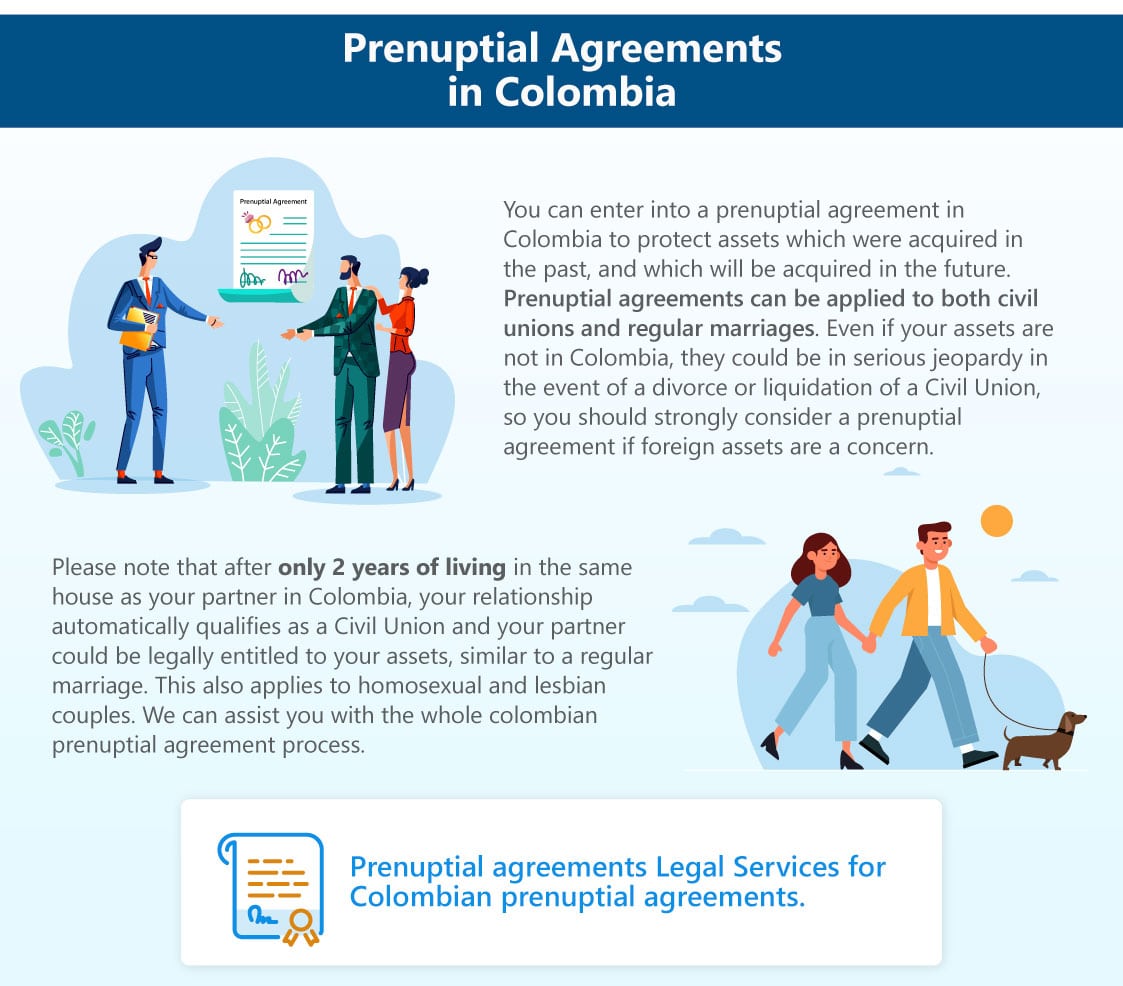
In Colombia, a prenuptial agreement, formally termed capitulaciones matrimoniales, is a legal contract entered into by prospective spouses before their Civil Marriage or de facto union. Its fundamental purpose is to regulate the economic consequences of the marriage, particularly concerning the management and division of marital property and individual assets and debts. While the default marital property regime in Colombia is the sociedad conyugal (community property or marital partnership), capitulaciones matrimoniales allow couples to opt out of this default or modify its terms according to their specific wishes. This agreement serves as a clear roadmap for financial matters throughout the marriage and, if necessary, in the event of its dissolution, contributing to overall financial security.
The Colombian Legal Framework
The Legal Framework for prenuptial agreements in Colombia is primarily established within the Colombian law, most notably the Código Civil Colombiano. Colombian legislation allows individuals to enter into these agreements to establish a different marital property regime than the default sociedad conyugal. The core principle is that parties have the autonomy to contractually agree on how their assets and debts will be managed and divided. However, this autonomy is not absolute; the law imposes certain requirements for validity and enforceability, notably the formalization through a public deed executed before a notary public (notario público). The Legal Framework ensures that such agreements are entered into freely and with full disclosure, preventing coercion or deception and upholding Colombian legal standards.
Why Consider a Colombian Prenuptial Agreement? Beyond Just Protecting Assets
While the most commonly cited reason for a prenuptial agreement is asset protection, its benefits extend far beyond safeguarding individual wealth. A well-drafted capitulaciones matrimoniales can foster transparency, promote open communication, and prevent future conflicts, thereby strengthening the marital union itself. It’s a tool for proactive planning that contributes significantly to long-term financial security and peace of mind for both partners entering marriage in Colombia.
Protecting Pre-Marital Assets and Liabilities
One of the primary motivations for a prenuptial agreement is to clearly delineate assets and debts that each individual brings into the marriage. This includes real estate, savings, investments, businesses, and even liabilities like student loans or credit card debt. Without a prenup, assets acquired before the marriage can, under the default sociedad conyugal, become part of the marital property. A prenup ensures that pre-existing assets remain separate property, shielding them from claims by the other spouse or their creditors. This is particularly relevant when one partner has significant accumulated wealth or inherited property. The Colombian law permits this clear separation of asset ownership, offering peace of mind. Furthermore, it can define responsibility for pre-marital debt, preventing a spouse from becoming liable for the other’s past financial obligations, thereby safeguarding their individual financial future.
Defining Marital Property Regimes
In Colombia, if a couple does not execute a prenuptial agreement, the law automatically establishes the sociedad conyugal, or community property regime, which is a form of marital partnership. Under this system, most assets acquired during the marriage are considered joint property, regardless of who earned the money or whose name is on the title. A prenuptial agreement allows couples to choose an alternative marital property regime, such as separación de bienes (separate property), where each spouse maintains individual asset ownership, including those acquired during the marriage. Alternatively, they can create a hybrid regime tailored to their specific circumstances. This choice significantly impacts how marital property division occurs in case of divorce or the death of a spouse, ensuring clarity and adherence to the couple’s wishes.
Fostering Transparency and Preventing Future Conflicts
The process of creating a prenuptial agreement necessitates open and honest conversations about finances between partners. This dialogue, while potentially challenging, is crucial for building trust and understanding. By discussing financial expectations, spending habits, and future goals together, couples can identify potential friction points and reach mutual agreements before they escalate into major conflicts. This transparency is a cornerstone of a healthy marital union. In Colombia, where proactive marital planning through a prenup can help maintain marital stability, this open communication is invaluable. It sets a precedent for honest dialogue throughout the marriage, contributing to long-term financial security and reducing the likelihood of future disputes regarding marital property.
Addressing Specific Financial and Personal Scenarios
Prenuptial agreements can be customized to address a wide array of specific financial and personal scenarios. This might include provisions for children from previous relationships, the management of family businesses, future inheritances, or the protection of specific valuable assets like intellectual property or unique collections. For instance, concerning real estate, the increasing number of homeowners in Colombia highlights the need to protect these significant assets. Similarly, it underscores the importance for individuals to protect their individual asset ownership through a prenup, especially in contexts where one partner brings substantially more wealth or property into the union. A prenup can also clarify how significant future acquisitions, such as real estate investments or business interests, will be treated, ensuring that specific financial goals and protections are formally recognized as a legal contract.
Three articles Similar to Colombia Prenuptial Agreement:
 Explore What is a Colombian Property Investor Visa and start your investment journey today!
 Learn the steps for how to get Colombia Real Estate Investment Visa by visiting Colombia Visas now!
 Find out how to secure your Colombia Digital Nomad Visa quickly at Colombia Visas!

|
|


Your Step-by-Step Guide to Getting a Colombian Prenuptial Agreement
Securing capitulaciones matrimoniales involves a structured process guided by legal requirements and mutual understanding between partners. This formal legal process ensures that your agreement is valid and enforceable under Colombian law, providing a solid framework for your financial future.
Step 1: Seek Expert Legal Guidance and Advice
The most critical first step is to engage a qualified attorney in Colombia specializing in family law and prenuptial agreements. This professional will explain the nuances of Colombian law, the implications of different marital property regimes, and guide you through the entire process. It is highly advisable for each partner to have their own independent legal counsel to ensure their rights are fully protected and that the agreement is fair and legally sound. This ensures the legal contract is drafted correctly and is enforceable, providing essential legal support. Seeking expert legal guidance is paramount to navigating the complexities of the Colombian prenuptial agreement process.
Step 2: Open Communication and Achieving Mutual Agreement with Your Partner
Before consulting an attorney, or concurrently with legal advice, couples must engage in open and honest discussions about their financial situations, expectations, and concerns. This is where you collaboratively decide on the key terms of your prenup. The goal is to reach a mutual consent that both partners feel is fair and equitable. Without genuine consent and understanding, the prenup could be challenged later. This transparent dialogue about asset ownership and financial goals is foundational to a healthy marital union and a robust legal contract.

Step 3: Comprehensive Information Gathering and Asset Inventory
You and your partner will need to conduct a thorough inventory of all your respective assets and debts. This includes detailing bank accounts, investments, real estate, vehicles, business interests, intellectual property, as well as mortgages, loans, and any other financial obligations. Providing full disclosure and accurate financial information is a legal requirement and essential for the validity of the prenup. This detailed Asset Inventory forms the factual basis for the capitulaciones matrimoniales, ensuring the public deed accurately reflects the couple’s financial standing before marriage.
Step 4: Drafting the Prenuptial Agreement (Capitulaciones Matrimoniales)
With the guidance of your attorney or attorneys, the legal contract will be drafted. This document will detail how your assets and debts will be treated during the marriage and in the event of dissolution. It will specify the chosen marital property regime, outline the treatment of future acquisitions, and address any other specific concerns agreed upon by the couple. This meticulous document preparation ensures that the capitulaciones matrimoniales precisely reflect your intentions and comply with all Colombian legal standards.
Step 5: Notarization – Formalizing the Public Deed
Once the draft is finalized and both parties are in agreement, the prenuptial agreement must be formalized as a public deed before a notary public in Colombia. This step is mandatory for the agreement to be legally valid. The notary public will ensure that both parties understand the contents of the document and are signing it voluntarily. The presence of both partners and their legal representatives (if applicable) is typically required during this process at the notary office. This legal formalization transforms the drafted document into a binding public instrument.
Step 6: Registration (Where Applicable) and Finalization
Depending on the nature of the assets involved, the public deed may need to be registered with relevant government offices. For example, changes to property ownership or records related to real estate typically require registration with the public registry. Your attorney will advise on any necessary registration steps to ensure the prenup is fully effective. Once notarized and registered (if required), the prenup becomes a legally binding legal contract, solidifying your chosen marital property regime and contributing to your financial security.
What a Colombian Prenuptial Agreement Cannot Cover
While a prenuptial agreement is a comprehensive legal contract, its scope is not unlimited. Certain matters are either outside its purview or cannot be included as enforceable clauses under Colombian law.
Limitations on Child-Related Matters
Prenuptial agreements in Colombia, as in most jurisdictions, cannot predetermine issues related to children. This includes matters of child custody, visitation rights, or child support payments. These decisions are always subject to the court’s determination based on the best interests of the child at the time of divorce or separation. Any clauses in a prenup attempting to dictate these issues will be deemed invalid and unenforceable by Colombian courts. The primary focus remains on marital property and financial matters, not child welfare.
Prohibited or Unenforceable Clauses
Certain clauses are prohibited by Colombian law or public policy and will render the agreement, or specific parts of it, invalid. These include provisions that encourage or facilitate divorce, clauses that are excessively unfair or unconscionable, or those that attempt to waive fundamental legal rights beyond financial matters. For instance, a clause that dictates personal lifestyle choices or imposes unreasonable financial penalties for minor disagreements would likely be unenforceable. A valid legal contract must adhere to ethical and legal standards.
Personal Non-Financial Matters
A prenup is primarily a financial legal contract. It cannot dictate non-financial aspects of the marriage, such as personal conduct, religious upbringing of children (beyond what courts may consider in custody decisions), household chores, or fidelity. While couples can discuss these matters and reach personal understandings, they cannot be legally enforced through a prenuptial agreement. The focus remains strictly on the division and management of assets and debts within the marital union.
Ensuring Validity and Navigating Potential Challenges
The strength of a prenuptial agreement lies in its validity and enforceability. Understanding the conditions that ensure its legal standing is crucial for its effectiveness under Colombian law.
Grounds for Invalidation or Challenge
A prenuptial agreement can be challenged and potentially invalidated on several grounds. These include fraud, duress, undue influence, misrepresentation, or the lack of full disclosure from either party. If it can be proven that one party was coerced into signing, did not fully understand the terms due to lack of information, or was misled about the other party’s financial situation, a court may set aside the agreement. The formal requirement of a public deed before a notary public is a key safeguard against many such challenges to this legal contract.
The Value of Independent Legal Counsel
The importance of each party having separate, independent legal counsel cannot be overstated. While one attorney can draft the agreement based on the couple’s joint instructions, having distinct legal counsel for each individual ensures that both parties’ interests are represented and that no one feels pressured or uninformed. This independent legal advice is a critical factor in demonstrating that the agreement was entered into freely and with full understanding, significantly strengthening its enforceability. This legal support is vital for fair asset division.
Review and Updates
While a prenuptial agreement is a binding legal contract, life circumstances change. It is often advisable for couples to review their prenup periodically, perhaps every 5-10 years or after significant life events such as the birth of children, a major career change, or the inheritance of substantial assets. While the agreement itself might not automatically change, a review can identify if the original terms still align with the couple’s current situation and financial goals. In some cases, a formal amendment or a new agreement may be necessary, which would also require notarization, ensuring the prenup continues to serve its purpose for financial security.
International Considerations: Essential for Expats and Bi-National Couples
For couples where one or both partners are not Colombian citizens, or if they own assets in multiple countries, navigating the prenuptial agreement process requires additional considerations to ensure international legal security.
Cross-Border Enforceability
Enforcing a Colombian prenuptial agreement in another country, or vice-versa, can be complex. The enforceability will depend on the laws of the foreign jurisdiction and any international treaties or agreements in place. It may be necessary to have separate prenuptial agreements drafted and executed according to the laws of each relevant country to ensure comprehensive protection of assets. Your attorney should be experienced in international family law or can liaise with foreign counsel to ensure your legal contract provides robust international coverage.
Specific Documentation for International Marriages
When one or both parties are foreign nationals, additional documentation may be required. This can include apostilled birth certificates, passports, proof of residency, and potentially translated legal documents from your country of origin, such as Certificates of Incorporation if applicable. If the marriage is registered in a country other than Colombia, documentation of that registration will also be necessary. Thorough preparation of personal documents, including a US Apostille for foreign documents and a Certified translation, is key to ensuring the legal contract is recognized and valid across jurisdictions, especially for those considering a Visa tipo M or other visas for a legal stay in Colombia.
Costs and Timelines: Practical Expectations for Your Prenup
Understanding the financial and time investment involved in obtaining a Colombian prenuptial agreement is essential for realistic planning.
The cost of a prenup in Colombia typically involves legal fees for the attorney or attorneys and notary registration fees for drafting and executing the public deed. Legal fees can vary significantly based on the complexity of the agreement, the attorneys’ experience, and the number of consultations required. Notary registration fees are generally standardized but can also depend on the value of the assets being declared. While difficult to provide exact figures without knowing specific circumstances, couples should budget for these expenses as an investment in future financial security. The timeline can range from a few weeks to several months, depending on the couple’s ability to gather necessary documentation and schedule appointments at the notary’s office.
Conclusion
Securing a Colombian prenuptial agreement, or capitulaciones matrimoniales, is a wise and responsible step for any couple preparing to enter marriage in Colombia. Far from being a sign of distrust, it is a powerful tool for fostering financial transparency, protecting individual assets and debts, and establishing clear expectations for the future. By navigating the Legal Framework with the guidance of experienced legal counsel, engaging in open communication, and formalizing the agreement through a notary public, couples can build a stronger, more secure foundation for their marital journey. This proactive approach ensures that the focus remains on building a shared life, free from the anxieties of potential financial disputes should the unexpected occur. Taking these steps is not about planning for divorce, but about safeguarding your financial future and fortifying your marital union with clarity and foresight.

What Clients Say About Working With Us
Real feedback from clients who have worked with our team on Colombian visa and legal processes.
Client feedback is sourced from publicly available third-party review platforms. Individual results may vary.
“I worked with Visas by James Medellín and had an excellent experience. Once I was connected with Isabela, I felt confident I was on the right path to obtaining my visa.”
— Mathew Sickler
“The Visas by James team helped significantly with my U.S. visa, and the process went much smoother than expected. They were knowledgeable and helpful throughout.”
— Mohan Chander Narasimman
“Visas by James is the company to use for visa services. My experience was excellent, and Lorena was absolutely amazing to work with.”
— Benjamin
“The team was responsive and professional. They provided clear guidance and helped me understand the visa process from beginning to end.”
— Robert Nepon
“Very professional service. All steps were clearly explained, and they helped me avoid mistakes that could have delayed my visa.”
— Reynaldo Araujo
“Overall, a positive experience. Communication was good, and the process was explained in a way that made sense for a foreigner.”
— Justin Halladay
Important Legal Disclaimer
The information on this page is provided for general informational purposes only and does not constitute legal advice, immigration advice, or a guarantee of any specific visa outcome.
Colombian visa requirements, procedures, government fees, and internal criteria change frequently and may vary depending on your personal situation and the policies in force at the time of your application.
Always consult a qualified professional to receive advice tailored to your individual case. Reading this website does not create an attorney–client relationship with Colombia Legal & Associates SAS, Visas by James, or any member of our team.