
Apostilles for Colombian Visas: 90-Day Rule, U.S. & Canada Requirements
For most expatriates, the challenge of moving to Colombia is not eligibility — it’s compliance.
One requirement causes more delays and rejections than almost anything else: improper apostilles for Colombian visas.
Under the authority of the Ministerio de Relaciones Exteriores, foreign public documents must be authenticated before Colombia will recognize them in a visa file. After approval, immigration enforcement and related compliance measures are overseen by Migración Colombia.
This guide explains what an apostille is, which visas commonly use apostilled documents, exactly how the U.S. and Canada processes work, and why timing (the practical 90-day document validity window) often determines whether a file moves smoothly or triggers a costly restart.
Official reference points used in this guide:
- Migración Colombia sanctions framework: Resolución 2357 de 2020
and Resolución 3770 de 2021. - Translation guidance (documents not in Spanish): Cancillería (Ministry of Foreign Affairs) FAQ.

Quick Facts: Apostilles for Colombian Visas
- Colombia recognizes apostilles under the Hague Apostille Convention.
- An apostille confirms the authenticity of a signature and seal — not the document’s content.
- In visa practice, supporting documents are commonly treated as valid for about 90 days from the document issuance date.
- The apostille date does not reset or extend the practical validity window tied to issuance date.
- Electronic apostilles can be acceptable if independently verifiable.
- Documents not in Spanish should be translated into Spanish after apostille, using a Colombian official translator (traductor oficial).
- Best risk control: obtain documents within the same short window so they share similar issuance dates (avoids domino replacements).
Related Topics of Interest for You:




|
|
What Is an Apostille for Colombian Visas?
An apostille is an official certificate issued by the competent authority in the country where a document originates.
It verifies the authenticity of the signature and seal so that Colombia recognizes the document under the Hague Apostille Convention.
Practical meaning: an apostille does not prove your pension amount, confirm your relationship, or validate your degree content.
It confirms that the document was officially issued (or properly notarized, where applicable) by an authorized entity.
That is why Colombia can reject a visa file even when the applicant clearly qualifies: if a supporting document is not legally recognized, it is treated as unusable for purposes of administrative review.
Why Colombia Requires Apostilles Under Resolution 5477
Colombia’s visa regime is governed by Resolution 5477 of 2022 issued by the Ministerio de Relaciones Exteriores. In practice, foreign public documents must be properly authenticated before they are accepted in a visa application.
For Hague Convention countries, apostille is the authentication method. If a country is not a Hague member, a consular legalization chain applies. If you are unsure which applies to your documents, start here: Apostille vs. Legalization for Colombia.
The “correctness” of an apostille is jurisdictional. A valid document can still be unusable if it was apostilled by the wrong authority. When that happens, the usual fix is a new issuance (or properly certified copy) and a new apostille — which consumes time and can trigger domino expirations.
Which Colombian Visas Require Apostilled Documents?
Apostilles are required whenever your visa file relies on foreign public documents — for example, civil status records, criminal records, financial certifications, or corporate documents. The visa category determines what you need to prove, but the apostille rule is triggered by the document itself.
Marriage Visa (M – Spouse of Colombian National)
If you were married outside Colombia, your marriage certificate must be apostilled for visa support. If you have a prior divorce and you submit divorce documentation to support civil status history, those records must also be apostilled. Related guide: Apostilles for Marriage Visa Colombia.
Work Visa (M – Trabajo)
Work visas commonly rely on apostilled degrees, professional licenses, and criminal background checks. The issuing authority and document type matter as much as the content. Related guide: Apostilles for Colombian Work Visa.
Business / Investor Visa (M – Inversionista)
Investor filings often use apostilled corporate documents (formation records, certificates of good standing, resolutions, powers of attorney).
These documents can also be relevant in Colombian notarial and Chamber of Commerce processes where foreign corporate acts must be recognized. Related guide: Corporate Document Apostilles for Investor Visa Colombia.
Digital Nomad Visa (V – Nómada Digital)
Digital nomad applicants commonly submit apostilled criminal background checks and, where self-employed, business registration documents that support their professional or corporate structure. Related guide: Criminal Record Validity Rules for Colombian Visas.
Rentista (Passive Income) Visa
Rentista filings often rely on financial documents such as bank letters, investment certifications, trust documents, or sworn income affidavits.
If a file uses corporate-based income or structured distributions, it is common to add corporate evidence (for example, a certificate showing an entity is active) as supporting context. Whether it is necessary depends on the structure of the income proof you are submitting.
If your file includes multiple foreign documents, the safest approach is to list every document you plan to upload and confirm apostille jurisdiction for each one before you order anything. That simple step prevents the most common, expensive apostille mistakes.
The 90-Day Document Validity Rule Explained
Compliance Warning: The 90-Day Window Is Measured From the Document Issuance Date
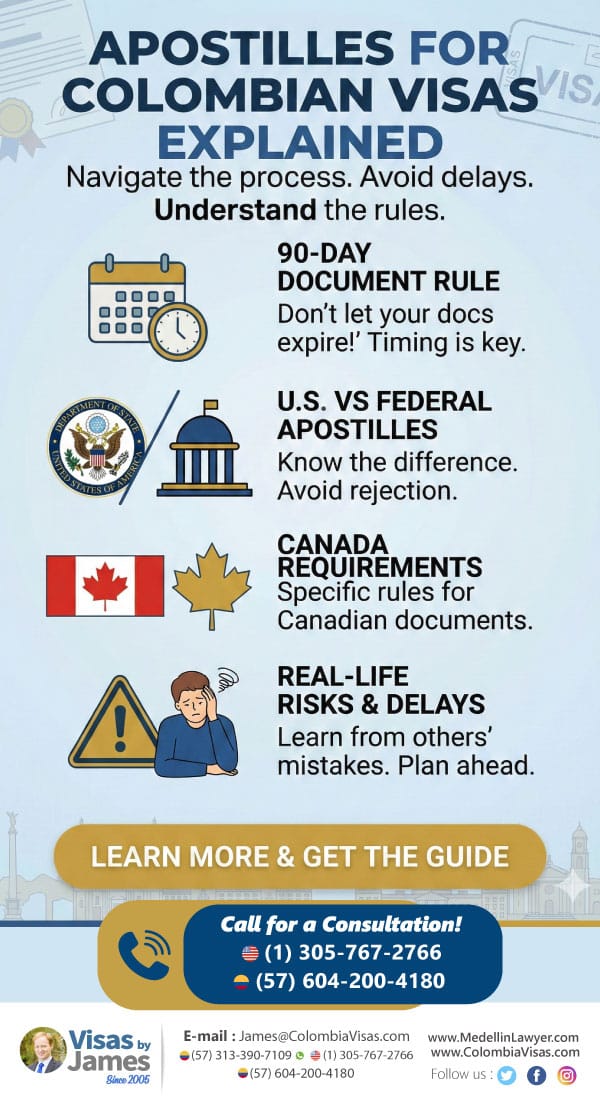
In visa practice, supporting documents are commonly treated as valid for about 90 days from the date printed on the document (issuance date). The apostille date does not reset or extend that practical validity window.
How the 90-Day Clock Is Calculated
The practical window is tied to the document’s issuance date — not the translation date and not the upload date. If a visa officer reviews your file after a key document has aged beyond the practical window, an updated document may be requested. Any flexibility is discretionary and should not be treated as a planning assumption.
This is most visible with criminal background checks, but it can also affect documents intended to show current status, such as bank certifications, pension letters, and corporate certificates.
Why Staggered Documents Create a Domino Effect
When documents are obtained on different dates, they expire on different dates. If one document must be replaced late in the process, the replacement cycle (new issuance, apostille, translation) can push other documents beyond the practical 90-day window.
This is why it is so important to build a document visa plan and obtain all documents within the same short issuance window, so they share similar date stamps. This reduces the chance that one replacement triggers a chain reaction.
A practical risk-control target many expats use is: submit before “Day 60,” leaving buffer time for processing and document requests before Day 90. This does not guarantee a timeline, but it reduces avoidable expiration risk.
Real Client Scenario: The “Domino Expiration” Problem
A U.S. applicant filed from inside Colombia and obtained documents in phases: the marriage certificate first, then a bank letter, then a criminal record weeks later. Each document had a different issuance date.
By the time the file reached review, the marriage certificate was outside the practical window. The officer requested an updated version, which required a new certified copy, a new apostille, and a new translation. During that replacement cycle, the bank letter also aged out.
Result: one expired document turned into multiple replacements and weeks of delay. The fix was a synchronized document plan so future filings used a single issuance window. For deeper timing and document freshness modeling, see: Criminal Record Validity Rules for Colombian Visas.
Apostille Process in the United States (Secretary of State vs Federal)
Compliance Warning: Apostille Authority Depends on Who Issued the Document
State-issued documents must be apostilled by the Secretary of State of the state that issued the document.
Federal-issued documents (for example, an FBI background check) must be apostilled by the U.S. Department of State. There is no overlap.
In the United States, apostille jurisdiction is determined by the issuing authority. Your current place of residence does not change which state (or federal office) controls the apostille.
- State-issued documents → Secretary of State of the issuing state
- Federal-issued documents → U.S. Department of State
Real-Life Examples: Marriage Certificates (Texas, Florida, New York)
These examples are meant to remove ambiguity about apostille jurisdiction for common civil status documents.
Texas marriage certificate: if the marriage certificate was issued by the State of Texas as a certified vital record, the apostille must be issued by the Texas Secretary of State. An apostille from Florida or New York would be the wrong authority for a Texas-issued certificate.
Florida marriage certificate: if the certificate was issued in Florida, the apostille must be issued by the Florida Secretary of State. Moving to another state later does not change which state has apostille jurisdiction.
New York marriage certificate: if the certificate was issued in New York, the apostille must come from the New York Secretary of State under the New York issuance framework. Again, your current residence does not determine apostille jurisdiction.
Real-Life Examples: Corporate Documents and Certificates of Good Standing
A Certificate of Good Standing is a state-issued certificate showing that an entity is registered and in good standing under that state’s records. It commonly appears in investor filings and can also be used as supporting evidence in digital nomad or business-visitor-type filings where the applicant is demonstrating an active business entity.
It may also appear in rentista files when income is structured through an entity and the applicant wants to show the entity exists and is active.
Whether it is required depends on what your case is using the document to prove.
Florida Certificate of Good Standing (Florida LLC): this is a Florida state document. If you include it, the apostille must come from the Florida Secretary of State.
New York Certificate of Good Standing (New York entity): this is a New York state document. If you include it, the apostille must come from the New York Secretary of State.
Texas business registration evidence (Texas entity): if the entity document is issued by the State of Texas, the apostille must be issued by the Texas Secretary of State.
Federal Example: FBI Background Check
The FBI Identity History Summary is a federal document. It must be apostilled by the U.S. Department of State. A state Secretary of State cannot apostille a federal document. Step-by-step guidance: How to Apostille an FBI Background Check for Colombia.
Real Client Scenario: State vs Federal Apostille Mix-Up (U.S.)
A client ordered an FBI Identity History Summary and sent it to a state Secretary of State for apostille. The state office could not apostille a federal document, which caused a rejection and lost time.
The fix required restarting the apostille step through the U.S. Department of State. That extra processing time pushed other documents closer to the 90-day window.
Takeaway: FBI documents require a federal apostille. State Secretaries of State cannot apostille federal documents.
Apostille Process in Canada (Provincial vs Federal Authority)
Canada joined the Hague Apostille Convention in 2024. Apostille authority depends on whether the document is provincial or federal. Sending a document to the wrong authority usually results in delay or rejection.
- Provincial documents → Apostille from the competent authority of that province
- Federal documents → Apostille from Global Affairs Canada
Real-Life Examples (Canada)
Ontario marriage certificate: provincial issuance means provincial apostille authority.
RCMP criminal record check: federal issuance means apostille through Global Affairs Canada.
The practical approach is to identify the issuing authority first, then match the apostille authority. Detailed guidance: Canada Apostille Process for Colombian Visas.
Real Client Scenario: Local Police Letter vs RCMP Certified Record (Canada)
A Canadian applicant submitted a local police clearance letter assuming it would work as a criminal record. The visa officer requested a formal certified record instead.
The applicant then had to obtain the RCMP-certified check, apostille it through the correct federal channel, and translate it — adding weeks and increasing the risk that other documents would expire under the 90-day rule.
Takeaway: confirm the exact type of criminal record required before ordering, apostilling, and translating.
Visa Timeline Flow Model: How to Avoid the Domino Effect
The strongest risk-control strategy is synchronization: issue documents within the same window, apostille immediately, translate promptly, and submit early enough to preserve buffer time. This reduces the chance that one replacement will trigger a cascade.
Phase 1: Eligibility Confirmation (Week 0–1)
- Confirm the correct visa category and your complete document list
- Confirm whether apostille or consular legalization applies If unsure, start here: Apostille vs. Legalization for Colombia.
Phase 2: Coordinated Document Issuance (Week 2–4)
- Order criminal background checks (often the tightest validity constraint)
- Request civil status documents (marriage/divorce) if required for your category
- Request financial letters (bank letters, pension certifications, investment statements)
- Request corporate certificates (investor/business/self-employed documentation)
Planning rule: obtain everything within the same 2–3 week issuance window so your documents share similar date stamps.
Phase 3: Apostille Window (Week 4–6)
- Apostille immediately after issuance (don’t hold documents “for later”)
- Confirm the competent authority (state vs federal / provincial vs federal)
- Confirm verification works for any electronic apostille
U.S.: How to Apostille an FBI Background Check for Colombia
Canada: Canada Apostille Process for Colombian Visas
Phase 4: Translation (Week 6–7)
- Translate the complete apostilled document (including apostille)
- Use a Colombian official translator (traductor oficial) and keep the file clearly matched to the authenticated original
See: Colombian Visa Translation Requirements.
Phase 5: Submission Target (Before Day 60)
- Submit while documents are fresh to preserve buffer time
- Plan for document requests without risking the 90-day window
If you are filing from inside Colombia, align this model with your remaining authorized stay so a document request does not force you into irregular status.
Before You Order Any Apostilles
If you are inside Colombia or working with a tight timeline, plan the apostille sequence before you request a single document. The most common avoidable problem is mismatched issuance dates that force replacements and reset timelines.
A document visa plan — listing required documents, competent authorities, and target issuance dates — helps ensure everything is issued within the same window, apostilled correctly, translated correctly, and submitted with buffer time. Request a Document Visa Plan Review | Check Apostille vs. Legalization First
Action Checklist: Your Document Visa Plan
- List every document required for your visa category.
- Confirm issuing authority and apostille authority for each document (state vs federal / provincial vs federal).
- Obtain all documents within the same 2–3 week issuance window (similar date stamps).
- Apostille immediately after issuance; preserve verification details for electronic apostilles.
- Translate the complete apostilled document into Spanish using a Colombian official translator (traductor oficial).
- Submit before Day 60 to preserve buffer time and reduce domino-expiration risk.
What Happens If Your Legal Stay Expires in Colombia?
Compliance Warning: If You Become Irregular, Visa Processing May Stop
If your authorized stay expires while a visa is pending or while you are replacing documents,
visa processing may be affected until your status is regularized. Approvals after time runs out are discretionary and not guaranteed.
If a foreign national remains in Colombia beyond their authorized stay, Migración Colombia may initiate an administrative sanction process. The sanctions framework is set out in
Resolución 2357 de 2020 and modified by Resolución 3770 de 2021.
Under this framework, fines are expressed and calculated in UVT (Unidad de Valor Tributario), not as a fixed peso amount. The final peso amount depends on the UVT value in force and the specific facts of the case.
The authority evaluates factors such as duration of irregular stay, prior compliance history, and aggravating or mitigating circumstances to determine the final sanction amount within the permitted ranges.
Can Fines Be Reduced or Negotiated?
During the administrative process, mitigating factors can influence the final fine imposed.
There is no guaranteed “negotiation right,” but authorities may apply discretion within the legal range and in light of the case circumstances.
The sanctions framework also operates with defined ranges and limits by infraction category; in practical terms, the amount does not increase indefinitely without limit. The outcome depends on the administrative evaluation and the applicable infraction category.
Risk of Deportation, Expulsion, or Entry Bans
Very long periods of irregular stay, repeated violations, or failure to comply with administrative orders can lead to more serious measures, including administrative expulsion, deportation orders, and temporary bans on re-entry. Not every overstay results in deportation, but prolonged or repeated irregular presence increases risk.
Real Client Scenario: Overstay + Document Expiration Combined Risk
An applicant delayed replacing an expired criminal record while waiting for apostille processing. During that time, their authorized stay expired. The resulting sanction process and compliance steps delayed their ability to move forward cleanly with the visa application. The underlying issue was not eligibility — it was timing and document synchronization.
For applicants inside Colombia, the strategic point is simple: avoid allowing document replacement cycles to overlap with the end of your authorized stay. That is exactly why a synchronized document visa plan matters.
Electronic Apostilles: Are They Accepted for Colombian Visas?
Compliance Warning: Electronic Apostilles Must Be Verifiable
If an electronic apostille is not independently verifiable (active link/code and a matching document), it may be treated as unauthenticated. Preserve the complete file and verification method exactly as issued.
Electronic apostilles can be acceptable when issued by a competent authority and independently verifiable. Officers may verify authenticity. If verification fails, the document may be treated as unauthenticated.
Best practice: preserve the original file exactly as issued and keep the verification method accessible. Avoid print-and-scan workflows that can break verification features.
Translation Requirements After Apostille
Compliance Warning: Translate After Apostille Using a Colombian Official Translator
If a document is not in Spanish, translate the complete document after apostille so the translation corresponds to the authenticated version. For Colombian legal and immigration processes, applicants should use a Colombian official translator (traductor oficial).
See Cancillería guidance: Documents presented in a language other than Spanish.
Translation is a common friction point because the officer evaluates whether the translation has legal effect in Colombia. The cleanest workflow is: apostille first, then translate the apostilled version, including apostille page(s) and any notarial certification text. See: Colombian Visa Translation Requirements.
FAQ: Apostilles for Colombian Visas
Do all documents for Colombian visas expire after 90 days?
In visa practice, supporting documents are commonly treated as valid for about 90 days from the document issuance date.
This often includes criminal records, financial certifications, civil status documents, and corporate records. The apostille date does not reset the practical validity window tied to issuance date.
Can I apostille a U.S. marriage certificate from a different state?
No. The apostille must come from the Secretary of State of the state that issued the marriage certificate. A Texas-issued marriage certificate must be apostilled in Texas; a Florida-issued certificate must be apostilled in Florida; a New York-issued certificate must be apostilled in New York.
Can Colombian visa officers approve a visa after my legal stay expires?
Occasionally, approvals happen 1–2 weeks after time runs out if the application was submitted on time and the file was complete.
However, this is discretionary and not guaranteed. Planning should assume you must remain in authorized status.
Should I translate documents before uploading them?
If a document is not in Spanish, it should be translated into Spanish. For Colombian legal and immigration processes, applicants should use a Colombian official translator (traductor oficial), and the best practice is to translate after apostille so the translation matches the authenticated version.
What’s the safest overall strategy for expats?
Create a document visa plan, obtain documents within the same 2–3 week issuance window, apostille immediately, translate promptly with a Colombian official translator, and submit before Day 60 to preserve buffer time and reduce domino-expiration risk.
Is the 90-day rule counted from the apostille date or the document issuance date?
It is generally counted from the document issuance date. The apostille date does not reset or extend the practical 90-day window.
What is a Certificate of Good Standing, and why does it appear in visa files?
A Certificate of Good Standing is a state-issued certificate showing a company is registered and in good standing with that state.
It often appears in investor or business documentation, and it may be used as supporting evidence in digital nomad or business-visitor-type filings where the applicant is demonstrating an active business entity. It can also appear in rentista files when income is structured through an entity and the applicant wants to show the entity exists and is active.
The apostille must be issued by the same state that issued the certificate.
Do electronic (digital) apostilles work for Colombian visas?
They can be acceptable if issued by a competent authority and independently verifiable. The underlying document still needs to be within the practical validity window tied to issuance date.
Are Migración Colombia fines fixed monthly amounts?
Resolución 3770 de 2021.
Conclusion: Apostilles + Timing = Legal Stability in Colombia
Apostilles for Colombian visas determine whether your foreign documents are legally recognized in Colombia. Because documents are commonly treated as valid for about 90 days from issuance, timing is structural — not secondary.
The safest approach is to synchronize document issuance dates, apostille immediately, translate after apostille using a Colombian official translator, and submit with buffer time. This prevents domino expirations, reduces rework, and protects legal stability, especially when filing from inside Colombia. Talk to us about a document visa plan | Confirm apostille vs. legalization

Lo Que Dicen Nuestros Clientes
Opiniones reales de clientes que han trabajado con nuestro equipo en procesos legales y de visas colombianas.
Los testimonios provienen de plataformas públicas de reseñas de terceros. Los resultados pueden variar según cada caso.
“Trabajé con Visas by James Medellín y tuve una experiencia excelente. Desde que me asignaron a Isabela, sentí confianza de estar en el camino correcto para obtener mi visa.”
— Mathew Sickler
“El equipo de Visas by James me ayudó enormemente con mi visa de EE. UU. y el proceso fue mucho más fluido de lo esperado. Siempre demostraron conocimiento y disposición para ayudar.”
— Mohan Chander Narasimman
“Visas by James es la empresa indicada para trámites de visas. Mi experiencia fue excelente y Lorena fue absolutamente increíble para trabajar.”
— Benjamin
“El equipo fue muy profesional y siempre respondió con rapidez. Me explicaron el proceso de visa de principio a fin de forma clara.”
— Robert Nepon
“Servicio muy profesional. Cada paso fue claramente explicado y me ayudaron a evitar errores que podrían haber retrasado mi visa.”
— Reynaldo Araujo
“En general, una experiencia positiva. La comunicación fue buena y el proceso se explicó de una manera clara para un extranjero.”
— Justin Halladay
Aviso Legal Importante
La información contenida en esta página se proporciona únicamente con fines informativos generales y no constituye asesoría legal,
asesoría migratoria ni garantía de un resultado específico en un trámite de visa.
Los requisitos, procedimientos, tarifas gubernamentales y criterios internos para visas colombianas cambian con frecuencia y pueden
variar según su situación personal y la normativa vigente al momento de presentar la solicitud.
Siempre consulte con un profesional calificado para recibir asesoría adaptada a su caso particular. La lectura de este sitio web no
crea una relación abogado–cliente con Colombia Legal & Associates SAS, Visas by James ni con ningún miembro de nuestro equipo.